
The federal EV tax credit is gone. The IRS says the $7,500 new clean vehicle credit isn’t available for vehicles acquired after Sept. 30, 2025, and the used EV credit of up to $4,000 ended on the same date. That leaves state and utility programs as the only real EV money for most US buyers. As of Nov. 11, 2026, we confirmed open programs in California, Colorado, Connecticut, Delaware, Illinois, Massachusetts, New Jersey, New York and Rhode Island. Oregon has stopped taking new purchases.
Every amount below comes from the program’s own page. Funding runs out, so check the link before you sign anything. Pair this with our 2027 EV price tracker to see which cars fit under each program’s price cap.
Federal EV Tax Credits in 2026: What Ended and When
- New EV credit (30D): not available for vehicles acquired after Sept. 30, 2025. If you signed a binding contract and made a payment on or before that date, you may still qualify when the car is placed in service. IRS details.
- Used EV credit (25E): same Sept. 30, 2025 cutoff. IRS details.
- Home charger credit (30C): the IRS lists the 30% credit, up to $1,000 per item for individuals, for property placed in service from Jan. 1, 2023, to June 30, 2026. A charger installed after that window doesn’t qualify. IRS details.
State EV Rebates and Credits Open Right Now
| State | Program | New EV | Used EV | Key limits | Status (Nov. 11, 2026) |
|---|---|---|---|---|---|
| California | Clean Cars 4 All | Up to $12,000 | Up to $12,000 | Income-qualified, retire an older car, plus up to $2,000 for charging | Open through five air districts and the statewide Driving Clean Assistance Program |
| California | MyFirstEV (see SMUD’s EV page) | Up to $3,500 | Up to $1,750 | First-time EV owners, point of sale | Listed as active |
| Colorado | State EV tax credit | $750, plus $2,500 if MSRP is up to $35,000 | None | MSRP up to $80,000, leases of 2+ years count, can be assigned to the dealer | Open. Rules change for the 2027 tax year |
| Colorado | Vehicle Exchange Colorado | $9,000 | $6,000 | Income-qualified, trade in a gas or diesel car 12+ model years old or one that fails emissions. New MSRP up to $80,000, used price up to $50,000 | Open |
| Connecticut | CHEAPR | $1,500 standard, $4,500 with Rebate+ | Up to $5,000 with Rebate+ | Base MSRP under $50,000 | Open. Standard BEV rebate rose from $1,000 on Oct. 15, 2026 |
| Delaware | Clean Vehicle Rebate | $2,500 under $40,000 MSRP, $1,500 from $40,000 to $50,000 | $2,500 (price up to $40,000) | Apply within 90 days, leases of 36+ months count | Open |
| Illinois | Illinois EPA EV Rebate | $2,000, or $4,000 low-income | Same | Price up to $80,000, Illinois dealer, purchases only | Cycle open Aug. 1 to Dec. 31, 2026. Apply within 180 days of purchase |
| Massachusetts | MOR-EV | $3,500 to $6,000 | Check program page | Higher amounts depend on income and trade-in | Open |
| New Jersey | Charge Up New Jersey | $1,500, or $4,000 with Charge Up+ | None | Charge Up+ needs prequalification before the sale. Up to $250 extra for a home charger | Open. Applied at the dealer |
| New York | Drive Clean Rebate | $500 to $2,000 | None | $2,000 for 200+ miles of range, $500 if MSRP is over $42,000 | Open. Applied at the dealer |
| Rhode Island | DRIVE EV | $3,000 | $2,500 | Price caps apply to new and used | Open |
| Oregon | Oregon Clean Vehicle Rebate | Up to $7,500 (past purchases) | Up to $4,000 (past purchases) | Only purchases or leases from Aug. 25 to Nov. 4, 2026 | Closed to new purchases. Late applications may be waitlisted to spring 2027 |
Colorado’s EV Credit Changes in 2027
Colorado is the one state where waiting a few weeks could pay. For EVs sold or leased in the 2027 income tax year, the base credit rises from $750 to $2,000 for new EVs with an MSRP up to $50,000, and the extra $2,500 opens up to cars under $40,000 instead of $35,000. That second change would pull the Tesla Model 3 RWD ($36,990) and Hyundai Ioniq 5 SE Standard Range ($35,250) under the line. Vehicle Exchange Colorado stacks on top for income-qualified buyers trading in an old car.
Cheapest EVs After State Rebates
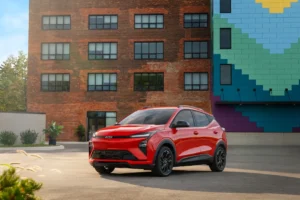
Price caps decide a lot. Connecticut’s $50,000 base MSRP cap, Delaware’s $40,000 line for the full $2,500 and Colorado’s $35,000 line for its bonus all favor the cheap end of the market. The 2027 Chevy Bolt LT ($27,600), Kia EV3 Light ($29,890), Nissan Leaf S+ ($29,990) and Equinox EV LT1 ($34,995) clear every cap on this page. Our 2027 Chevy Bolt and Kia EV3 guides have trim prices, and Best EVs to Buy compares them.
Utility EV Money: Check Your Power Company
Utilities often pay for the charger rather than the car. Sacramento’s SMUD, for example, offers its customers up to $850 toward home charging equipment and installation through Charge@Home. Colorado’s Energy Office also points buyers to utility rebates. Call your utility or check its EV page before you buy a charger, since many want you to apply first.
States We Couldn’t Confirm This Week
We couldn’t confirm the current status of programs in Maine, Maryland, Pennsylvania, Texas, Vermont and Washington from their official pages on Nov. 11, so they aren’t in the table. California’s old CVRP rebate has been closed since Nov. 8, 2023. We’ll add states as we verify them, and we recheck this page every month.
More EV data and tools: prices, state rebates, NACS ports, range rankings and the 2027 launch calendar are collected on our EV data page.





5 thoughts on “US EV Incentives by State: Where the Rebate Money Still Is After the Federal Credit Ended”