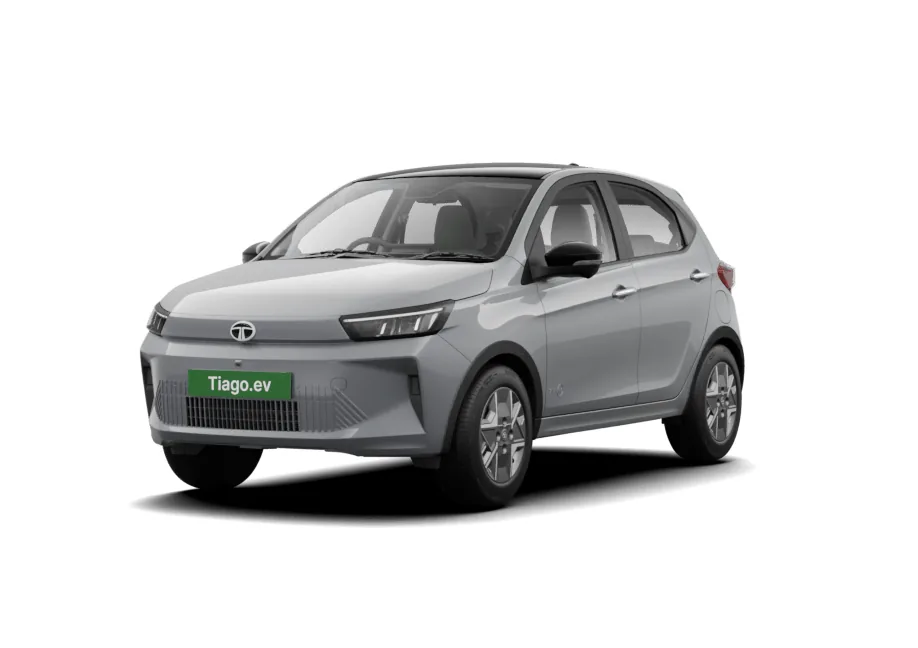
The Tata Tiago EV price starts at ₹6.99 lakh in India, about $7,400 at today’s exchange rate. That is a real, warrantied, five-seat electric hatchback with up to 285 km of claimed range. US buyers, meanwhile, can’t get a new EV for under about $29,000. Our take: the Tiago doesn’t belong in America, but the thinking behind it does.
Tata Tiago.ev price, battery and range: the confirmed numbers
Tata Motors Passenger Vehicles launched the updated Tiago.ev on May 28, 2026, at a starting price of ₹6.99 lakh for full ownership, according to Tata’s press release. It also offers a Battery-as-a-Service plan from ₹4.69 lakh plus ₹2.60 per km of battery rental. Autocar India lists four ex-showroom prices: Smart 19.2 kWh at ₹6.99 lakh, Pure+ 19.2 kWh at ₹8.49 lakh, Pure+ 24 kWh at ₹9.49 lakh and Creative+ 24 kWh at ₹9.99 lakh.
There are two batteries. The 19.2 kWh pack pairs with a 61 hp motor and carries an ARAI-rated range of 226 km (about 140 miles). The 24 kWh pack gets 75 hp and 285 km (about 177 miles). ARAI cycles are generous, though. Tata’s own Tiago.ev page quotes a real-world range of about 205 to 215 km (roughly 130 miles) for the bigger pack. Autocar India puts DC fast charging from 10 to 80 percent at about 35 minutes on a 30 kW charger. A 7.2 kW AC charger needs 2.6 to 3.5 hours for a full charge.
Tata calls the 24 kWh battery warranty “Lifetime,” and its fine print defines that as 15 years for the first owner. Later owners get 8 years or 160,000 km. Tata says more than 700,000 customers have bought a Tiago across all powertrains. It does not give an EV-only figure in that release, so we won’t guess one. Tata also says EV penetration in India’s sub-₹12 lakh segment is below 2 percent. Even at this price, cheap EVs are a hard sell there too.
The conversion, and why it flatters the Tiago
We converted at ₹94.75 per US dollar, the European Central Bank reference rate published on November 3, 2026 (via Frankfurter). Indian ex-showroom prices leave out road tax, registration, insurance and other levies. Tata’s own fine print says so. A US sticker works differently. A US-legal version would also need different safety hardware, crash certification and emissions paperwork. So treat the converted figures as a rough reference point, not a price.
| Model | Starting price (USD) | Battery / range | What the price includes |
|---|---|---|---|
| Tata Tiago.ev Smart 19.2 kWh (India) | ~$7,380 (₹6.99 lakh, converted) | 19.2 kWh / 226 km ARAI (~140 mi) | Indian ex-showroom; excludes road tax, registration, insurance. Converted at ₹94.75/$ (Nov 3, 2026). Not sold in the US. |
| Tata Tiago.ev Creative+ 24 kWh (India) | ~$10,540 (₹9.99 lakh, converted) | 24 kWh / 285 km ARAI (~177 mi) | Same basis as above |
| 2027 Chevrolet Bolt LT | $28,995 | 65 kWh / 262 mi EPA | GM-listed MSRP; excludes tax, title and dealer fees |
| 2026 Nissan Leaf S+ | $29,990 ($31,485–$31,565 with destination, per trade press) | 303 mi EPA | MSRP; destination extra |
| 2026 Chevrolet Equinox EV LT 1 FWD | $36,795 | 319 mi EPA | GM-listed MSRP |
US prices: GM newsroom (Bolt, Equinox EV); Cars.com, October 2026 (Leaf with destination).
Cheap EVs in the US: what’s reported about costs, tariffs and credits
Batteries are still the biggest cost lever. BloombergNEF’s December 2025 survey found average lithium-ion pack prices of $108/kWh, with EV packs under $100/kWh. It also found a big regional gap: about $84/kWh in China against $121/kWh in North America. At the North American figure, the pack alone in a 65 kWh Bolt would cost close to $8,000, more than the entire base Tiago.ev.
The federal $7,500 credit for new EVs is also gone. It ended September 30, 2025, under the budget law signed that summer, Reuters reported, and S&P Global notes that it took the $4,000 used-EV credit with it. US sticker prices now have to stand on their own.
Trade policy is the other wall. US tariffs on Chinese imports, including vehicles and battery inputs, rose sharply in 2025. BloombergNEF’s analysis of those tariffs shows how quickly they add to battery costs. We could not confirm one current, all-in tariff rate for an Indian-built car, so we’re leaving out a specific number.
Lesson one from the Tiago.ev: size the battery to the job
The Tiago’s pack is less than a third the size of the Bolt’s. That single choice explains much of the price gap. Our view: US carmakers have chased 300-mile ratings because buyers asked for them. A commuter-sized battery, around 40 kWh in a US car, with honest marketing about who it suits, is the most direct path to a lower sticker. The trade-off is real, though. Highway speeds, cold winters and long distances between chargers punish small packs far more in the US than in Indian city traffic.
Lesson two: fewer Tiago.ev-style trims, simpler specs
Tata sells four variants on one body, and it cut prices across the range for this update. The base Smart still gets six airbags and automatic climate control, but it doesn’t pile on features. In our view, fewer trims and option packages cut engineering, inventory and dealer complexity. GM is already moving that way: the Bolt comes in just two trims.
Lesson three: build where it’s cheap, but tariffs decide where that is
The Tiago is cheap partly because it is engineered, sourced and assembled in India, for India. A US brand can’t simply import that cost base. Tariffs and battery-sourcing rules push production and cells toward North America, where BNEF’s own numbers show packs cost more. Our take: a realistic $20,000 US EV would probably need US- or allied-sourced LFP cells, a body shared with a gas car, and a battery in the 40 to 50 kWh range. Even then it would still have to absorb US crash-safety hardware, destination fees and dealer margin. The Tiago’s price simply doesn’t include any of those.
Where the Tiago.ev comparison breaks down
It’s worth being blunt here. The Tiago.ev is smaller and slower than anything sold new in the US. It isn’t built to US federal safety standards, and its range figures come from a softer test cycle than the EPA’s. It isn’t sold here, and we’re not suggesting anyone try to buy one. The point is narrower. It shows that a usable EV is first an engineering and pricing decision, and US carmakers have mostly decided not to make that bet. For the cheapest electric cars actually on sale here, see our guide to upcoming Chevrolet and GM EVs for 2027.
Would you buy a $20,000 EV with 200 miles of range, or is that too compromised? Tell us in the comments.
Image: Tata Motors