
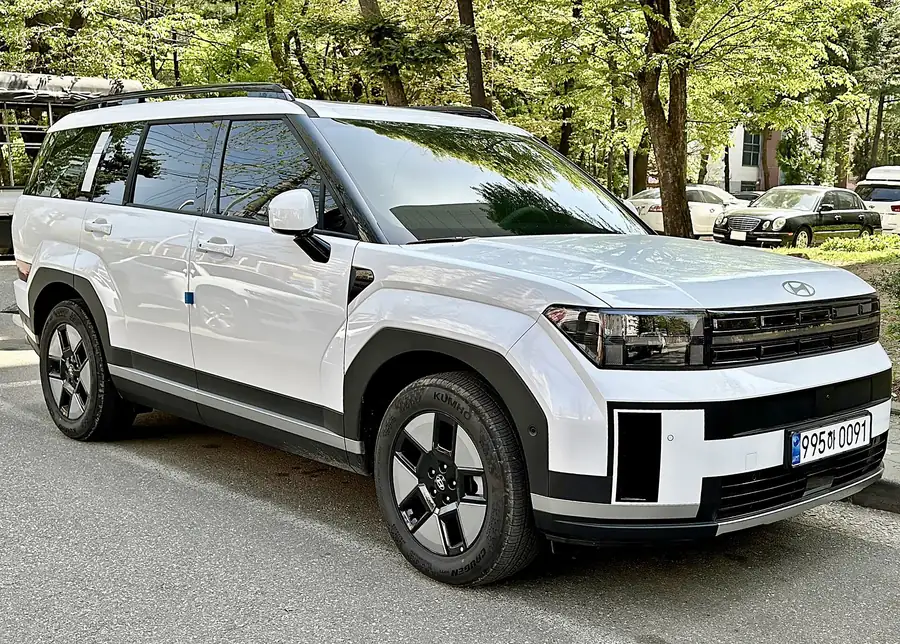
Hyundai’s first range-extended EV for America will be a Santa Fe, and the pitch is simple: more than 600 miles of total range from a battery less than half the size of a comparable EV’s. Hyundai says the Santa Fe EREV arrives in the first half of 2027 and will be built in Montgomery, Alabama. It hasn’t announced the price, electric-only range, horsepower or towing capacity. Two newer developments firm up the timeline. Hyundai announced a nearly $450 million investment in its Alabama plant on October 28, partly for EREV engines. And a Korean report on November 9 says North America will be one of the first markets to get Hyundai’s EREVs.
Here’s what Hyundai has said, what’s still reported or guessed, and whether a Santa Fe shopper should wait.
Hyundai Santa Fe EREV: The Facts Hyundai Has Put on Record
Most of the official detail comes from Hyundai’s 2026 CEO Investor Day release, dated August 26, 2026. In it, Hyundai says:
- The “first-ever Santa Fe EREV” will “arrive in the first half of 2027.”
- It’s “expected to deliver more than 600 miles of total range.”
- It “will be built in the United States at Hyundai Motor Manufacturing Alabama.”
- The EREV “uses less than half the battery capacity of a comparable EV” and gets Hyundai’s new in-house battery cells. Hyundai says those cells deliver more than double the output of its earlier high-nickel cells and charge 40% faster.
The Alabama side became official on October 28. The Alabama governor’s office said HMMA will invest “nearly $450 million” to expand engine production for hybrid and extended-range EV technology and to prepare the plant for the refreshed Santa Fe and the all-new Tucson. The same release puts the project’s capital investment at $412,885,541, with 53 new full-time jobs. The two numbers don’t match exactly. The headline figure is rounded, and the release doesn’t explain the gap. WardsAuto adds that the plant will build the all-new Tucson starting before the end of 2026, with the refreshed Santa Fe after it.
How the Santa Fe EREV Will Work
An EREV drives its wheels with electric motors only. The gas engine works as a generator that recharges the battery when it runs low. Car and Driver describes it as a type of plug-in hybrid that uses a smaller battery than a full EV and an engine that acts only as a generator. Car and Driver and Motor1 both say the Santa Fe EREV uses two electric motors, which suggests all-wheel drive, though neither outlet treats the drive layout as confirmed. Hyundai promises an “EV-like” driving experience and acceleration.
That 600-mile figure needs context. Today’s 2027 Santa Fe Hybrid already gets an EPA-estimated 637 miles of total range with front-wheel drive and 620 miles with AWD, according to Hyundai USA. So the EREV isn’t really about going farther on a tank. Its selling point is that you could cover a lot of daily driving on electricity and keep gas as a backup. How much daily driving depends on the electric-only range, which is the number Hyundai hasn’t given.
What Reporters Are Hearing About Hyundai’s First EREV
These points come from outlets, not from Hyundai’s own announcements:
- North America goes first. Korea’s Kukmin Ilbo reported on November 9 (Korea time) that Hyundai plans to begin full mass production and sales of EREVs in the first half of 2027. The paper says the Santa Fe and Genesis models will lead, with North America, Europe and China as the first markets. A Korean launch is still under review.
- Production starts early 2027. Motor1 reports that EREV assembly begins “early next year” alongside the regular Santa Fe in Alabama.
- It could be a 2028 model. MotorTrend expects a significant Santa Fe update for the 2028 model year, with slimmer headlights, new fascias, vertical taillights and possibly Hyundai’s Pleos infotainment system, based on camouflaged prototypes. MotorTrend says the EREV “could” use a 1.6-liter engine, but that’s unconfirmed.
- The Genesis version is unclear. Hyundai says Genesis will add an EREV SUV with more than 640 miles of range in early 2027. Motor1 says the teaser points to a GV80. Car and Driver says the GV70 is the likely first Genesis EREV. The reports conflict, so we’d wait for Genesis to say.
Santa Fe EREV vs. the Santa Fe You Can Buy Today
EREV figures marked “not announced” are gaps in Hyundai’s information. We didn’t fill them with guesses. Current-model numbers come from Hyundai USA’s 2027 Santa Fe Hybrid page.
| Santa Fe EREV | 2027 Santa Fe Hybrid | |
|---|---|---|
| US arrival | First half of 2027 (Hyundai) | On sale now |
| Starting MSRP | Not announced | $36,650 (SE); Calligraphy from $50,750 |
| Total range | 600+ miles (Hyundai target) | 637 mi FWD / 620 mi AWD (EPA est.) |
| Electric-only range | Not announced | Not a plug-in |
| Power | Not announced (two motors reported) | 231 hp combined |
| Towing | Not announced | 2,000 lb with trailer brakes |
| Built in | Montgomery, Alabama | Montgomery, Alabama |
If towing matters to you, note that the gas Santa Fe is rated higher than the hybrid. On the same Hyundai USA page, the gas trims (still listed as 2026 models) are rated at 3,500 pounds, or 4,500 pounds for the XRT. Whether the EREV can match those numbers is one of the biggest open questions for families who pull a camper or boat.
Santa Fe EREV Price and Release Date: Our Best Estimate
Release date. The Santa Fe EREV could reach US dealers in the first half of 2027, based on Hyundai’s own timeline and the Alabama production plans. If MotorTrend is right about the refresh, it may be sold as a 2028 model. Hyundai hasn’t said which model year it will carry.
Price. Hyundai hasn’t announced one, and we haven’t found a credible estimate. For reference, the 2027 Santa Fe Hybrid runs from $36,650 to $50,750. Our assumption is that the EREV will cost more than a comparable hybrid trim, since it needs a much larger battery than the hybrid’s 1.49-kWh pack and, reportedly, a second motor. That’s our reasoning, not something Hyundai or another outlet has said.
Tax credit. Don’t count on federal money. The IRS says the clean vehicle credit, which covered qualifying plug-in hybrids, ended for vehicles acquired after September 30, 2025.
The Range-Extender Rivals Coming to America
Hyundai isn’t the only brand moving this way. According to Car and Driver, Stellantis has an EREV coming in the Jeep Grand Wagoneer, followed by the Ram 1500 REV. Ford is said to be working on an EREV truck to replace the F-150 Lightning, which we track in our upcoming Ford EVs guide. Scout is exploring range extenders for the Traveler and Terra. Within Hyundai Motor Group, Kia has its own plans, covered in our look at the Kia Telluride EREV and hybrid pickup.
For everything else battery-powered from both brands, see our upcoming Hyundai and Kia EVs for 2027.
Should You Buy a Santa Fe Now or Wait for the EREV?
Buy the hybrid now if you want a three-row Hyundai with a known price, about 620 to 637 miles of range, and no need to plug in. It’s a proven package, and you can buy one today.
Wait for the EREV if you can charge at home and most of your driving is short trips. In that case, a range extender could cut your gas use a lot, depending on the electric range Hyundai eventually announces. Also wait if you want the refreshed styling MotorTrend expects.
Look elsewhere if you tow more than 2,000 pounds and need an answer now. The gas Santa Fe tows more, and Hyundai hasn’t published EREV towing figures.
What electric-only range would make a Santa Fe EREV worth it for you: 40 miles, 60 or more? Let us know in the comments.


3 thoughts on “Santa Fe EREV: 600+ Miles From LESS Than Half an EV Battery”