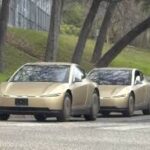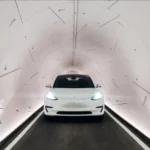
In a groundbreaking development for autonomous vehicles, Tesla’s Cybercab has been spotted undergoing highway testing for the first time in Austin, Texas. This sighting, captured on January 7, 2026, marks a significant milestone in Tesla’s push toward fully driverless robotaxis. As Elon Musk’s vision for a robotaxi network inches closer to reality, enthusiasts and industry watchers are buzzing about what this means for the future of transportation. If you’re searching for the latest on Tesla Cybercab updates, robotaxi technology, or autonomous driving advancements, read on for an in-depth analysis of this exciting event.
What is the Tesla Cybercab? A Quick Overview of the Robotaxi Revolution
The Tesla Cybercab, unveiled in October 2024 at the “We, Robot” event, represents Tesla’s ambitious entry into the robotaxi market. Designed as a fully autonomous, two-seater vehicle without a steering wheel or pedals in its production form, the Cybercab aims to redefine urban mobility. Priced under $30,000, it’s engineered for high-volume production and seamless integration into Tesla’s upcoming Robotaxi Network.
Key features of the Cybercab include:
- Autonomous Driving Capabilities: Powered by Tesla’s Full Self-Driving (FSD) hardware and software, including advanced AI from xAI integration.
- Sleek Design: A futuristic, compact body with inductive charging, butterfly-wing doors, and a minimalist interior focused on passenger comfort.
- Sustainability Focus: Built on Tesla’s next-gen platform, emphasizing efficiency and low-cost operation for ride-hailing services.
- Production Plans: Tesla has announced that mass production will begin in 2026 at its Giga Texas factory in Austin, with initial deployments targeted for Texas and California.
Unlike traditional vehicles, the Cybercab is purpose-built for autonomy, eliminating human controls to reduce costs and enhance safety. Elon Musk has projected that unsupervised FSD operations could start as early as 2026, paving the way for a fleet of millions of robotaxis.
The First Highway Sighting: Cybercab Hits Austin Freeways
On January 7, 2026, Tesla enthusiast Adan Guajardo shared a video on X (formerly Twitter) capturing a gold-wrapped Cybercab cruising on an Austin highway at night. This marks the first public confirmation of the robotaxi testing on high-speed freeways, expanding beyond previous urban street trials in downtown Austin and the Bay Area.
The original video, lasting about 59 seconds, shows the Cybercab smoothly navigating a multi-lane highway, maintaining lane position and speed without apparent intervention. A slow-motion version posted by Sawyer Merritt highlights the vehicle’s distinctive full-width LED taillights glowing red against the dark backdrop, emphasizing its aerodynamic silhouette.
From the footage:
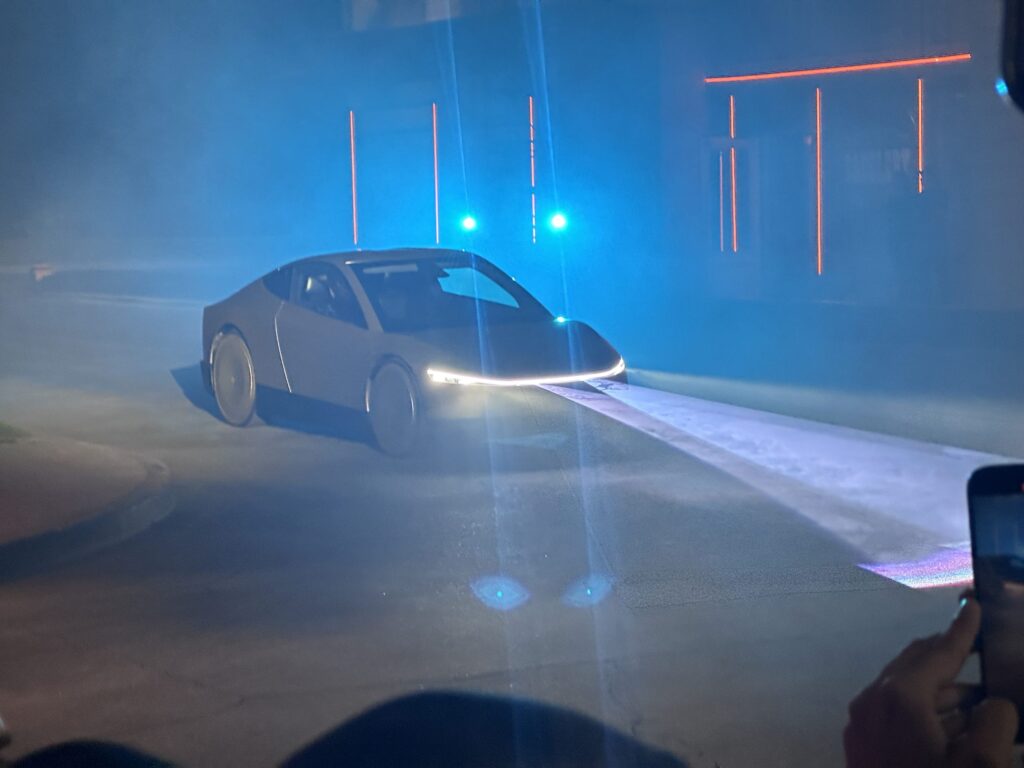
- Front View: The Cybercab’s slim LED headlights cut through the night, showcasing its low-profile design.
- Side Profile: As it passes, the absence of side mirrors (replaced by cameras) and the smooth, coupe-like body are evident.
- Rear View: The taillights form a continuous bar, illuminating the license plate and casting a red hue on the road.
- Performance: The vehicle appears to travel at highway speeds (estimated 60-70 mph), handling curves and lane markers effortlessly.
This sighting comes amid Tesla’s expansion of its Cybercab test fleet to seven vehicles, with operations in both Austin and the San Francisco Bay Area. Prior sightings in December 2025 showed prototypes with temporary steering wheels for safety drivers, indicating ongoing validation tests before full autonomy.
Video Analysis: Breaking Down the Austin Highway Test Footage
The videos provide a rare glimpse into real-world testing. In the full-speed clip, the Cybercab is seen from an overpass, approaching with its headlights on, then receding into the distance. No driver is visibly present through the windows, though safety protocols likely include remote monitoring or an onboard operator during early tests.
Notable observations:
- Nighttime Conditions: The test occurred under low-light scenarios, testing the vehicle’s sensor suite (cameras, radar, and potentially lidar alternatives) in challenging visibility.
- Speed and Stability: Smooth acceleration and deceleration suggest advanced FSD software handling highway dynamics.
- Wrap and Markings: The gold exterior could be a test camouflage, with “xAI” watermarks in the video hinting at AI-driven enhancements.
Community analysts on X noted the vehicle’s composure, with one user commenting, “Man it looks so good!” while others speculated on unsupervised capabilities.
Implications for Tesla’s Robotaxi Network and Autonomous Future
This highway test is a pivotal step toward Tesla’s 2026 robotaxi rollout. Highways present unique challenges like high speeds, merging traffic, and long-distance navigation, which FSD must master for widespread adoption. Successful testing could accelerate regulatory approvals in Texas, where Tesla has strong ties.
Broader impacts:
- Market Disruption: The Cybercab could undercut competitors like Waymo and Cruise, offering rides at potentially $0.20 per mile.
- Economic Boost for Austin: As Giga Texas ramps up, local job creation and tech innovation are expected.
- Safety and Regulation: With no steering wheel in production models, Tesla must demonstrate superior safety stats to regulators.
Elon Musk has teased expansions to airports and new markets by mid-2026, aligning with this sighting.
Production Timeline and What to Expect in 2026
Tesla’s roadmap for 2026 includes:
- April Start: Cybercab production begins at Giga Texas.
- Fleet Expansion: From current test units to thousands in operation.
- Software Updates: FSD v14+ iterations to enable unsupervised rides.
- Robovan Companion: A larger 20-seater variant for group transport.
Investors are watching closely, as robotaxis could drive Tesla’s valuation into the trillions.
Community and Industry Reactions to the Cybercab Highway Test
The X post by Sawyer Merritt garnered over 3,400 likes and 171,000 views within hours, with reactions ranging from excitement (“Can’t wait to see these around!”) to speculation (“Seems like legit testing”). Industry experts praise the rapid progress, noting Tesla’s fleet has grown from two to seven units since late 2025.
Critics, however, question timelines, citing past delays in FSD rollout.
The first Tesla Cybercab highway testing in Austin signals that 2026 could be the year autonomy goes mainstream. As sightings increase, expect more updates on FSD performance, regulatory hurdles, and market launches. For Tesla fans, investors, or anyone interested in EV innovations, this is a glimpse into a driverless future. Stay tuned for more Tesla Cybercab news, robotaxi developments, and autonomous vehicle breakthroughs.
If you’re in Austin, keep an eye out—who knows, the next sighting could be yours! For the latest on Tesla robotaxi testing, Elon Musk updates, or electric vehicle trends, bookmark this page and share your thoughts below.