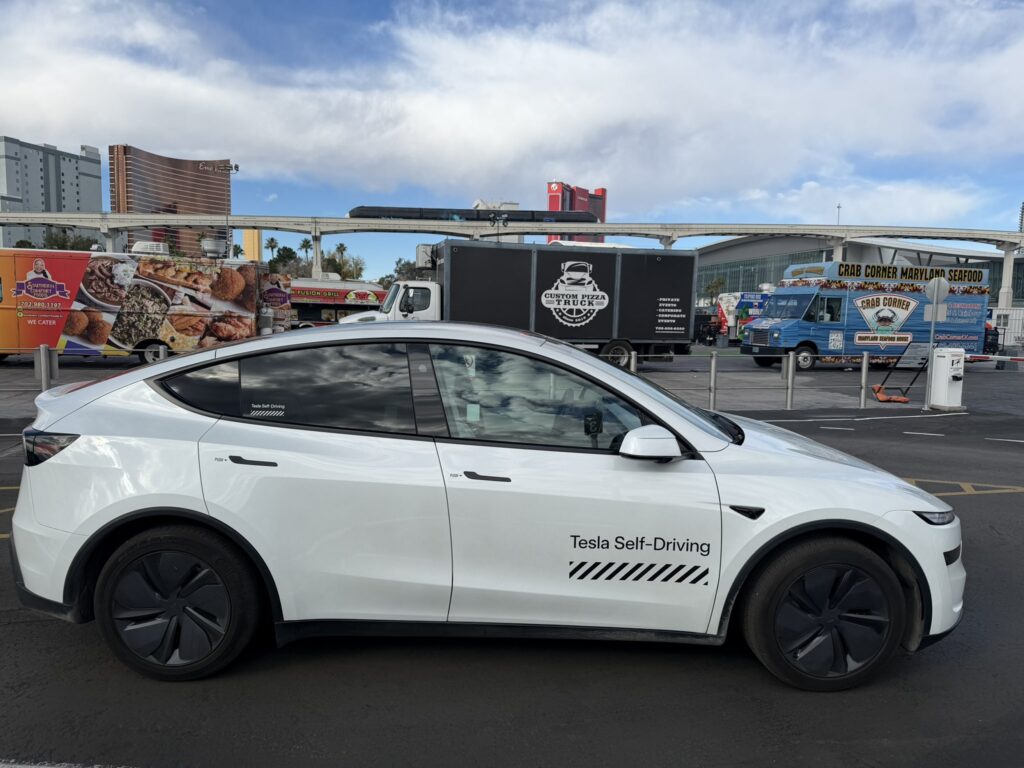
In the heart of Las Vegas, where innovation meets the neon lights, a recent sighting of a Tesla Self-Driving Model Y at the Vegas Loop has sparked excitement among tech enthusiasts and commuters alike. On January 8, 2026, a white Tesla Model Y emblazoned with “Tesla Self-Driving” was captured parked near food trucks at the Vegas Loop station, hinting at the ongoing expansion of autonomous vehicle technology in one of the world’s busiest cities.
What Is the Vegas Loop and How Does Tesla Fit In?
The Vegas Loop, developed by Elon Musk’s The Boring Company, is an underground transportation network designed to alleviate traffic congestion in Las Vegas. Launched initially in 2021, it has grown to include multiple stations connecting key locations like the Las Vegas Convention Center, resorts, and now even the airport. Tesla vehicles, specifically Model 3 and Model Y variants equipped with Full Self-Driving (FSD) technology, serve as the primary shuttles in this system.
Tesla’s involvement began with testing autonomous capabilities in the tunnels as early as August 2025. By October 2025, Elon Musk announced that the Tesla cars in the Vegas Loop would go driverless within a month or two, marking a significant milestone in urban mobility. Riders have reported smoother experiences with self-driving Teslas compared to human-operated ones, emphasizing the technology’s precision in controlled environments like tunnels.
Recent Developments in Tesla’s Autonomous Rides at Vegas Loop
As of late 2025, The Boring Company started offering public rides in self-driving Tesla Model Y vehicles within the Vegas Loop. These rides, while currently including safety drivers for regulatory and safety reasons, represent a step toward fully unsupervised autonomy. In November 2025, reviews highlighted the uneventful yet efficient nature of these trips, with vehicles navigating the 3.5-mile tunnel system flawlessly.
Entering 2026, expansions include routes to Harry Reid International Airport, blending tunnel and surface travel for now, with full underground connections expected in Q1. Riders at CES 2026 have shared videos of seamless journeys from the Convention Center to resorts like the Encore, all powered by Tesla’s FSD. One notable account described the ride as “insane,” noting how it bypasses Strip traffic effortlessly.
Challenges and Future Prospects for Autonomous Vehicles in Las Vegas
Despite the progress, challenges remain. Safety drivers are still mandated in many rides, and some users express disappointment over the lack of fully driverless options in such a controlled setting. Regulatory hurdles, weather impacts (like rain affecting competitor systems like Zoox), and scaling to handle more passengers are ongoing concerns.
Looking ahead, Tesla aims to expand robotaxi services, with the Vegas Loop serving as a proving ground. By mid-2026, full autonomy without safety drivers could become standard, potentially transporting thousands daily and reducing reliance on traditional rideshares. This could transform Las Vegas transportation, making it faster, greener, and more efficient
Why Tesla’s Self-Driving Tech Matters for Urban Mobility
Tesla’s Full Self-Driving suite, powered by advanced AI and camera-based vision, is at the forefront of autonomous vehicle innovation. In the Vegas Loop, it demonstrates real-world application, from precise navigation in tunnels to handling pick-up and drop-off zones. As adoption grows, expect similar systems in other cities, potentially revolutionizing how we travel.
If you’re in Las Vegas, head to the Convention Center or nearby stations to try a ride—many are free during events like CES. With Tesla leading the charge, the future of self-driving cars is no longer a distant dream but a tunnel ride away. Stay tuned for more updates as this technology evolves in 2026 and beyond