If you’re searching for “Tesla vehicles with Starlink” or “future Tesla connectivity features,” this development is a game-changer. Building on Tesla’s relentless push toward full self-driving (FSD) and robotaxi fleets, the patent could enable real-time data streaming in remote areas—perfect for off-grid adventures or long-haul autonomy.
Breaking Down the Tesla Starlink Patent: Key Technical Details
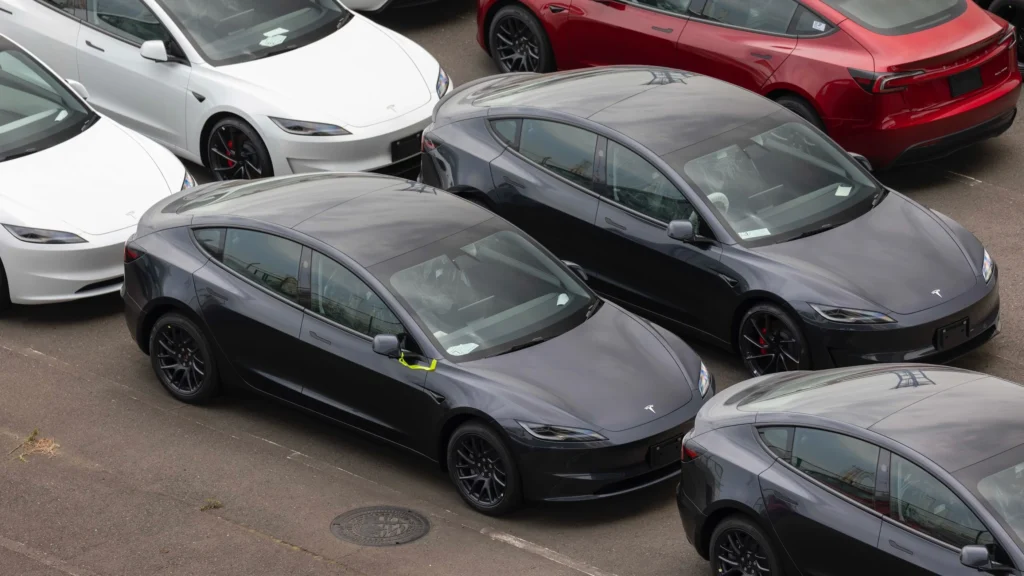
Filed on May 29, 2024, and published just last week on December 4, 2025, the patent describes a roof assembly made from RF-transparent materials like polycarbonate (PC), ABS, or ASA. Unlike traditional metal or glass roofs that block signals, this design embeds antennas, processors, and communication hardware right into the structure.
Key features include:
- Integrated Antennas for Multi-Band Support: Covers satellite comms (ideal for Starlink’s low-Earth-orbit network), LTE, Wi-Fi/Bluetooth, and GNSS navigation. The antenna field-of-view is optimized—0–30 degrees from the horizon for cellular and 75 degrees from zenith for GPS—ensuring robust performance even in motion.
- Consolidated Overhead Module: Combines microphones, speakers, fans, air ducts, map lights, and hazard switches into one pre-assembled unit. This slashes assembly time by 3–5 times and boosts factory automation by allowing horizontal, upside-down builds.
- Weather and Safety Innovations: Addresses ice/snow buildup without heaters or wipers, while a polymer membrane deflects impacts to meet head injury criteria. It also enhances headroom, thermal insulation, and noise reduction for a premium in-cabin experience.
This isn’t just a roof—it’s a smart, signal-friendly platform that could make “shark fin” antennas obsolete, paving the way for native Starlink hardware in upcoming models like the refreshed Tesla Model Y Performance 2025, whose deliveries kick off next week.
Implications for Tesla Owners: Goodbye Dead Zones, Hello Hyper-Connected Drives
Imagine cruising through the Rockies or deserts with flawless Starlink streaming—no more buffering Netflix during family road trips or dropped FSD updates in rural spots. This Tesla Starlink integration could supercharge safety too: Vehicles communicating in real-time to alert nearby drivers of hazards, much like the vehicle-to-vehicle (V2V) chatter envisioned in Tesla’s Robotaxi breakthrough in Nevada.
For off-road enthusiasts, it’s a boon—pair it with the blistering performance of the upcoming Tesla Roadster 2026, and you’ve got a supercar that’s as connected as it is supersonic. Even urban dwellers benefit: Enhanced GNSS for pinpoint FSD navigation, echoing the recent FSD Supervised demo that wowed Rome’s mayor.
The patent doesn’t explicitly name Starlink, but its satellite-friendly architecture screams compatibility with Elon Musk’s space-tech empire. As Tesla’s ecosystem converges—think FSD V14’s “door-to-door amazing” autonomy—this roof could be the missing link for truly global, always-on EVs.
Buzz from the Tesla Community: Excitement Builds on X
Tesla insider Sawyer Merritt broke the news on X, sparking a frenzy of speculation. “NEWS: Tesla could be laying early groundwork for Starlink-enabled vehicles,” he posted, linking to the patent details. Replies poured in, highlighting the hype:
- @LinkN01 (Applications Engineer): “That is cool! However, tunnels and parking structures. Will I still be able to connect to my car?” Merritt’s candid reply: “TBD I suppose.”
- @mweinbach (Analyst at Creative Strategies): Noted that current 5G modems in new cars already support Starlink’s direct-to-cellular band 25 in North America, sharing a spec image for proof.
- @kaynat_kakar (AI Enthusiast): “If Tesla adds Starlink directly into the roof, cars won’t just drive; they’ll stay connected anywhere. Huge move.”
- @teslayoda: “Convergence of Elon’s companies is becoming more overt and necessary.”
- @team_pgr: Shared how Starlink Mini already streams race telemetry through glass roofs, teasing even broader applications.
Even a cheeky jab from @BillSabo11: “Don’t tell Lucid or tomorrow they’ll say they’re launching their own satellites 🛰️ 🤣”
This chatter underscores the patent’s potential to disrupt not just Tesla’s lineup but the entire EV connectivity landscape.
What’s Next for Tesla’s Starlink Vision?
As Tesla accelerates toward a fully autonomous, interconnected future, this RF-transparent roof patent feels like the foundation for Starlink-powered vehicles rolling out by 2027. It aligns perfectly with Musk’s multi-company synergy, blending Tesla’s EV prowess with SpaceX’s orbital might.
Stay tuned to USonWheels.com for updates on “Tesla Starlink features,” FSD rollouts, and more EV innovations. Have thoughts on integrated satellite tech? Drop them in the comments below—could this be the connectivity upgrade your next Tesla needs?
Sources: Drive Tesla Canada [via patent publication]; Community reactions from X (formerly Twitter). Images courtesy of Tesla and public domain renders.