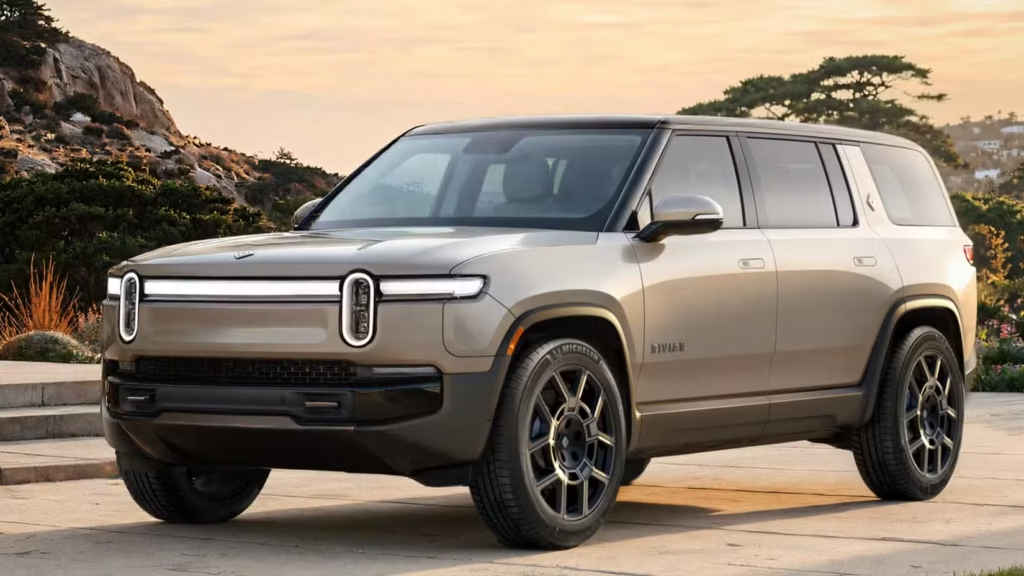
The Rivian R1S is the three-row electric SUV that treats school runs, ski weekends, and actual dirt as the same job. Built in Normal, Illinois, and closely related to the R1T pickup, it combines a boxy adventure look, seven-seat packaging, serious off-road geometry, and—on the flagship Quad—more than 1,000 horsepower.
If you are comparing a Rivian R1S price, EPA range, towing rating, or how it stacks up against a Tesla Model X, this guide covers the current lineup, real-world capability, and who the SUV actually fits.
Rivian R1S at a glance
| Item | Typical 2026 figures |
|---|---|
| Body | 7-seat electric SUV |
| Starting price (official) | About $83,990 (Premium Dual-Motor) |
| Flagship price | About $121,990 (Quad) |
| Power | 533 hp to 1,025 hp |
| 0–60 mph (claimed) | About 4.5 s down to 2.6 s |
| EPA range | About 258–410 miles, config-dependent |
| Towing | 7,700 lb |
| Ground clearance | Up to about 14.7–15 in |
| Water fording | About 43 in |
| Charging | Native NACS + CCS adapter; peak DC around 200–220 kW |
Sources disagree slightly on exact entry MSRP because destination fees, Dual Standard availability, and mid-year packing changes move the “from” number. Rivian’s own site currently leads with Premium from $83,990, Performance from $106,990, and Quad from $121,990. Reviewer guides often quote Dual Large around $85,885 once destination is added.
What’s new on the 2026 Rivian R1S
The R1S is no longer a first-year experiment. The 2026 model year is a second-generation product with a few high-visibility changes:
- Native NACS charging port on every 2026 R1S, so Tesla Superchargers are first-class destinations. A CCS adapter is still included.
- The Quad-Motor returns with 1,025 hp and 1,198 lb-ft, plus independent control of each wheel. Rivian claims 2.6 seconds to 60 mph in Launch mode.
- Software extras such as Kick Turn (tight-spot rotation using opposing wheel direction) and more tunable drive modes on higher trims.
- Carry-over Gen-2 hardware: in-house Enduro drive units, quieter cabin work, zonal electronics, and a structural battery pack designed to fix early-owner complaints.
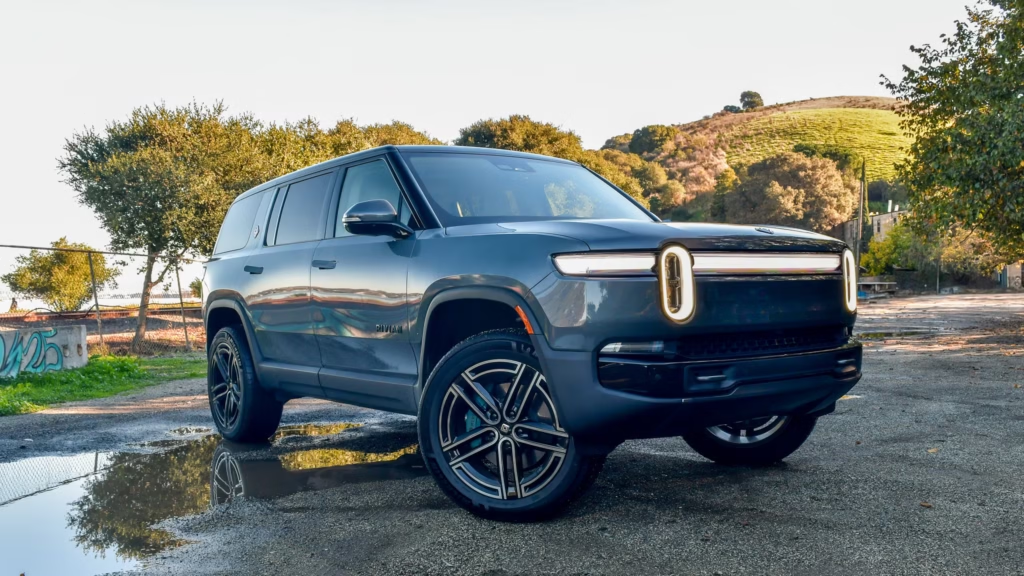
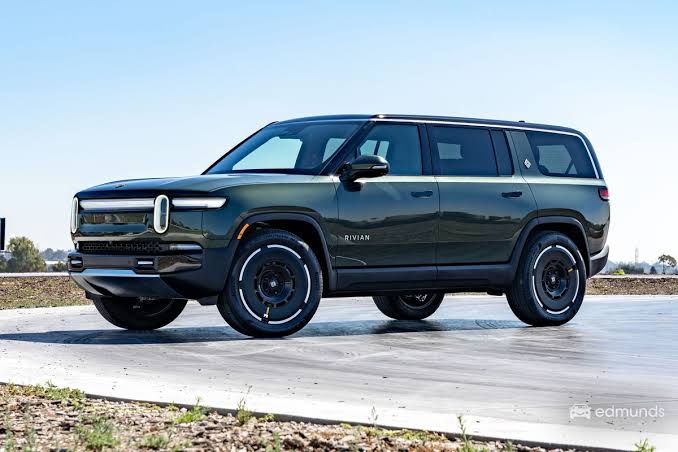
The look is still unmistakably Rivian: vertical “stadium” LED headlights, short overhangs, and a wagon-like silhouette that reads more expedition rig than crossover.
Rivian R1S price and trims
Think of the lineup as three personalities rather than a maze of option codes.
Premium (Dual-Motor)
From about $83,990. Dual-motor AWD, 533 hp standard and up to 665 hp with the Power Upgrade. Best everyday choice for most families. Official range is 329 miles on the Long Range setup and up to 410 miles on the biggest Dual-Motor battery. Acceleration is as quick as 3.4 seconds with the upgrade.
Performance (Tri-Motor)
From about $106,990. Three motors, 850 hp, 1,103 lb-ft, claimed 2.9-second 0–60. EPA range is about 371 miles, or around 405 miles in Conserve mode. This is the “enough power that the Quad feels optional” trim.
Quad
From about $121,990 (Launch Edition a few thousand higher in some listings). Four motors, 1,025 hp, 1,198 lb-ft, claimed 2.6-second 0–60. Range is about 374 miles, or around 400 miles in Conserve. This is the traction and theater package: one motor per wheel, Kick Turn, Launch mode.
Older Dual Standard listings around $76,990–$78,885 with a smaller LFP pack and roughly 258–270 miles of range still appear in third-party databases. Confirm current availability on Rivian’s configurator before you treat that as a live order price.
Value pick: Dual-Motor with the Large or Max battery. You keep the long-range numbers, still get AWD and 7,700-pound towing, and avoid paying six figures for acceleration you will use once a month. Several outlets land in the same place.
Performance: from family SUV to sports-car numbers
Every R1S is all-wheel drive. The difference is how many motors do the work.
| Setup | Power / torque | Claimed 0–60 | Character |
|---|---|---|---|
| Dual-Motor | 533 hp / 610 lb-ft | ~4.5 s | Fast enough, most efficient |
| Dual + Power Upgrade | 665 hp / 829 lb-ft | ~3.4 s | Sports-SUV punch |
| Tri-Motor | 850 hp / 1,103 lb-ft | ~2.9 s | The sweet-spot halo |
| Quad-Motor | 1,025 hp / 1,198 lb-ft | ~2.6 s | Independent-wheel control |
Independent testers have clocked Tri-Motor models around the claimed 2.9 seconds. Quad results have been mixed: some runs match Rivian’s number, others land closer to 3.0 seconds—still absurd for a ~7,000-pound seven-seater.
On pavement the air suspension is the secret. Ride height drops for the highway, body control is tighter than the square body suggests, and one-pedal driving makes the big SUV easy in traffic. It is not a sports sedan. It is far more composed than a traditional body-on-frame off-roader.
Range, batteries, and charging
Range is the first question buyers ask. The honest answer: it depends on battery, motors, wheels, and speed.
Approximate pack map used across 2025–2026 reviews:
- Standard (~92.5 kWh, LFP): about 258–270 miles
- Large (~108.5 kWh): about 329 miles
- Max (~140 kWh): up to 410 miles on Dual-Motor; about 371 / 374 miles on Tri / Quad
Wheels matter. Twenty-two-inch road tires help the EPA number; 20-inch all-terrains cost range. Highway tests at a steady 75 mph often land well below the sticker—Car and Driver recorded about 250 miles in one Tri-Motor Max highway loop—so plan trips with a buffer.
Charging in 2026
- Native NACS port
- Included CCS adapter
- Peak DC around 200–220 kW
- 10–80% typically in the 30–40 minute range, longer on the biggest pack
- Onboard AC around 11.5 kW (overnight home charging)
The NACS change is the practical upgrade. Supercharger access plus trip planning in the Rivian app is what most owners will feel every week, not the extra 175 horsepower on the Quad.
Off-road ability: the R1S’s real differentiator
This is where the R1S stops being “another three-row EV.”
- Max ground clearance: about 14.7–15 inches
- Approach / departure: about 35.8° / 34.4°
- Breakover: about 29.6°
- Water fording: about 43 inches
- Drive modes: All-Purpose, All-Terrain, Snow, plus Rock Crawl, Soft Sand, Rally, Drift, and Conserve on higher trims
Quad-Motor models can send torque to whichever wheel still has grip and use Kick Turn in tight trail spots. Reviewers who have taken the R1S onto serious dirt keep repeating the same point: the geometry—short overhangs, high ride, good angles—matters as much as the motor count.
Towing is 7,700 pounds across the lineup with the proper hitch setup (5,000 pounds without a weight-distributing hitch, per Rivian). That beats Tesla Model X (5,000 pounds) and most luxury EVs. Expect range to drop hard with a trailer; that is physics, not a Rivian-only quirk.
Interior, seating, and cargo
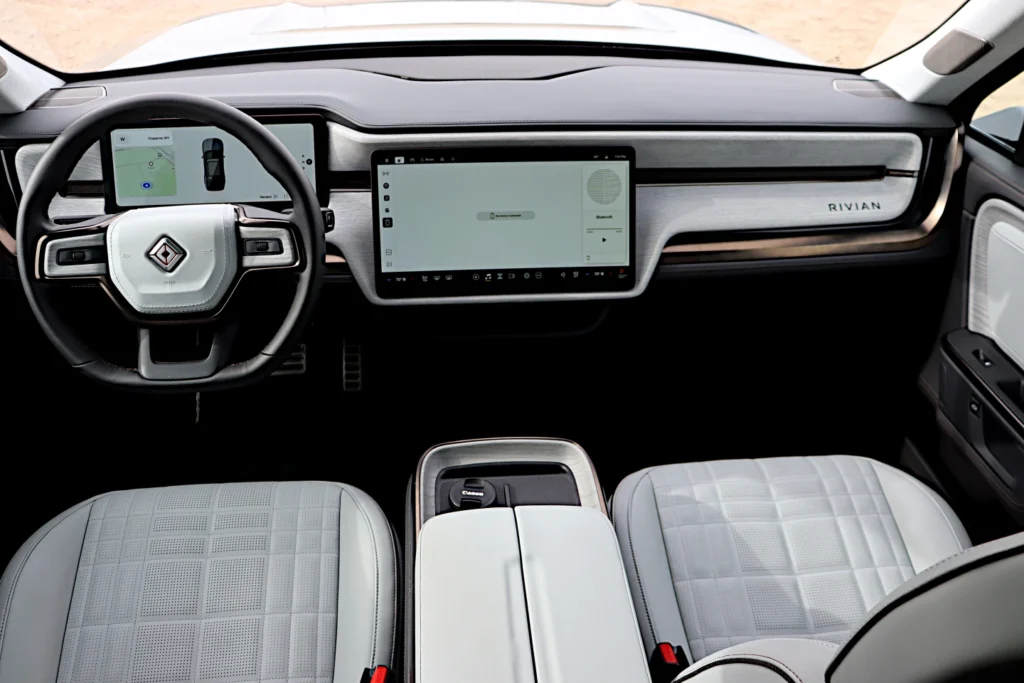
The cabin is clean rather than flashy: a wide center touchscreen, a driver display, vegan leather or leatherette, and a glass roof. Second-row captain’s chairs are a frequently requested option on newer configurations. Third-row space is usable for kids and shorter adults; it is not a Tahoe.
Cargo is a strength versus other electric three-rows:
- Behind the third row: about 17.7–18 cu ft
- Behind the second row: about 46–49 cu ft
- Max with rows folded: about 91–105 cu ft depending on how the figure is measured
- Frunk: about 10–11 cu ft
Add underfloor bins, a powered frunk and tailgate, and the usual Rivian touches (gear hooks, built-in flashlight, Camp Mode that levels the air suspension). It is a family truck that still looks like it belongs at a trailhead.
Safety and driver assistance
The refreshed R1S earned IIHS Top Safety Pick+, the Institute’s highest award, and has been called out as the only large American-brand SUV to take that honor in its test year. Headlights were the usual near-miss (Acceptable rather than Good in some reports). NHTSA has not been a consistent public tester of Rivian under NCAP.
Standard kit includes automatic emergency braking, lane-departure warning, blind-spot monitoring, rear cross-traffic alert, adaptive cruise, and a camera/radar suite. Autonomy+ is Rivian’s paid enhanced-driving layer; it does not add extra sensors on the 2026 car in some descriptions—it unlocks more software on the existing hardware.
Warranty language varies by source and powertrain. Expect roughly 4 years / 50,000 miles or 5 years / 60,000 miles bumper-to-bumper, and 8 years / 150,000–175,000 miles on the battery and drivetrain. Confirm the exact card on the window sticker.
Rivian R1S vs Tesla Model X and other rivals
Tesla Model X is quicker in some Plaid form, more efficient, and usually faster at a Supercharger. The R1S wins on third-row usefulness, cargo, towing, ride height, and off-road hardware. If your life is highways and charging speed, Model X still makes sense. If your life includes dirt, bikes, and a trailer, the Rivian is the more complete SUV.
Land Rover Defender still owns analog trail cred and a gasoline/diesel support network. The R1S answers with silent torque, air-suspension height, and far lower running costs if you charge at home.
Kia EV9, Hyundai Ioniq 9, Cadillac Vistiq, Lucid Gravity are the other three-row EVs. They are often cheaper or more efficient. None of them match the R1S’s combination of 7,700-pound towing, 15-inch clearance, and 1,000-hp option.
Who should buy a Rivian R1S
Buy it if you want:
- A seven-seat EV that can actually leave pavement
- 7,700-pound towing without stepping up to a full-size truck
- Distinct design instead of another rounded crossover
- Over-the-air software and a growing Supercharger-friendly network
Skip it (or wait) if you want:
- Maximum efficiency and the lowest cost per mile
- The fastest public charging curve in the class
- A bargain three-row (the Dual Max and everything above it is premium money)
- A tiny service network in very rural areas—Rivian has grown, but it is not Toyota
Frequently asked questions
What is the Rivian R1S starting price in 2026?
Official Premium pricing starts around $83,990 before destination and options. Some Dual Standard listings still appear lower. Quad models start around $121,990.
What is the Rivian R1S range?
EPA estimates run from the mid-250s on the smallest Dual pack to 410 miles on Dual-Motor Max. Tri and Quad Max sit in the low-to-mid 370s, with Conserve mode near 400. Real highway range is lower.
Can the R1S tow?
Yes. Maximum rating is 7,700 pounds.
Does the 2026 R1S use Tesla Superchargers?
Yes. 2026 models have a native NACS port and include a CCS adapter.
How many people does it seat?
Seven, or six with second-row captain’s chairs where offered.
Is the Quad-Motor worth the extra money?
Only if you want per-wheel control, Kick Turn, and the headline 1,025 hp. For most owners, Dual Max or Tri Max is the rational spec.
Bottom line
The Rivian R1S remains one of the few electric SUVs that does not force a choice between family space and trail ability. The 2026 updates—NACS, a 1,025-hp Quad, and a quieter, more finished Gen-2 chassis—make it easier to live with than the first cars that rolled out of Normal in 2022.
Spec Dual-Motor Max if range and value matter. Spec Tri if you want the grin without the flagship price. Spec Quad if you want the party trick. In every case, check current configurator pricing, wheel-and-tire range impact, and local service coverage before you put money down.