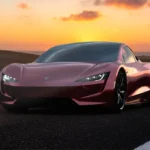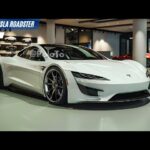
The Tesla Roadster is two cars sharing one name: the 2008–2012 Lotus-based two-seater that proved a lithium-ion EV could be a real sports car, and the long-delayed second-generation supercar Tesla first showed in 2017. That next-gen Roadster is scheduled for a public reveal on October 1, 2026 in Waco, Texas — nearly nine years after the prototype rolled onto a stage.
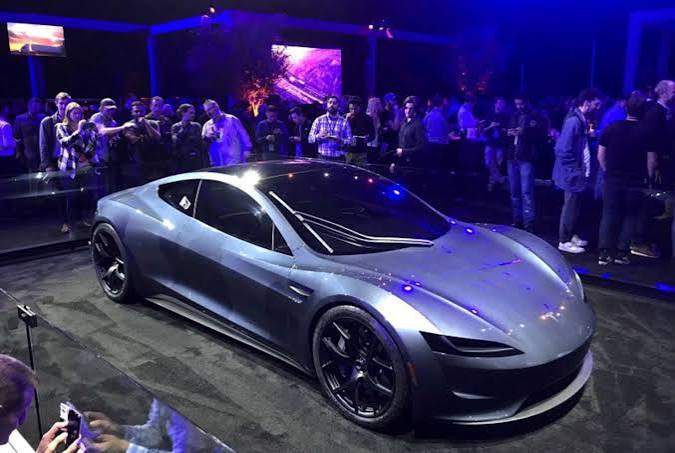
Tesla still publishes the 2017 targets on its Roadster page: 0–60 mph in 1.9 seconds, a top speed over 250 mph, and 620 miles of range, with four seats and all-wheel drive. None of those figures has been independently tested on a production car. Customer production is still expected in 2027 or 2028 at Gigafactory Texas, not on reveal day.
This guide covers both generations, the claimed specs, the SpaceX thruster package, pricing and reservations, and what the October event is actually likely to show.
Tesla Roadster at a Glance
| Original Roadster (2008–2012) | Next-gen Roadster (announced 2017) | |
|---|---|---|
| Status | Production ended; ~2,450 built | Pre-production; reveal Oct 1, 2026 |
| Layout | 2-seat convertible, RWD | 2+2 coupe, removable glass roof, AWD |
| Powertrain | Single AC induction motor | Triple-motor AWD (claimed) |
| 0–60 mph | 3.7–3.9 seconds | 1.9 seconds claimed (base) |
| Top speed | ~125 mph | Over 250 mph claimed |
| Range | ~244 miles EPA (53 kWh) | 620 miles claimed (~200 kWh) |
| Price when launched / announced | About $98,950–$109,000 | $200,000 base / $250,000 Founders Series (2017; not reconfirmed) |
| Built | Lotus (Hethel) + Tesla (California) | Planned: Gigafactory Texas |
The original Roadster made Tesla real. The second one is meant to be the company’s halo product — if the production numbers survive the reveal.
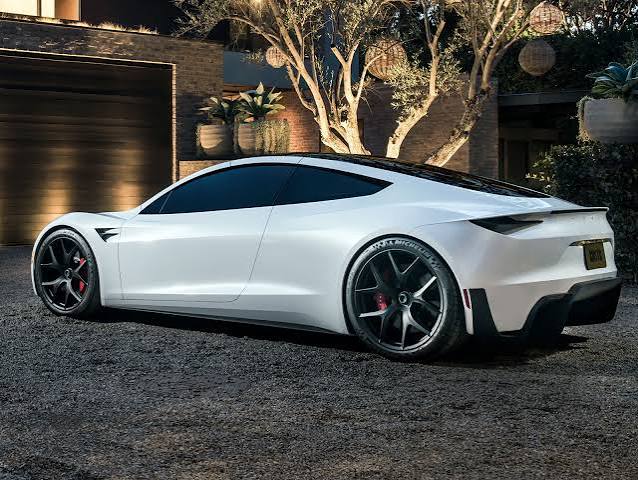
Original Tesla Roadster (2008–2012): The Car That Started Tesla
Tesla’s first product was not a family sedan. It was a $100,000 two-seat sports car based on the Lotus Elise chassis. The company needed a halo vehicle that could show range and performance at the same time, then use the cash and credibility to fund the Model S.
Why Tesla used a Lotus
Building a car from scratch in 2005 was too expensive for a startup. Tesla bought Elise “gliders” (rolling chassis without an engine) from Lotus, lengthened the wheelbase by about two inches for the battery pack, stiffened the aluminum tub, and replaced the gasoline powertrain with an electric motor and a pack of thousands of laptop-style lithium-ion cells.
The result looked like a close cousin of the Elise — same compact footprint, same low seating position — but it was hundreds of pounds heavier because of the battery.
Original Tesla Roadster specs
- Motor: Rear mid-mounted AC induction, rear-wheel drive
- Power: 248 hp on early cars; up to 288 hp on later 2.5 / Sport models
- Torque: About 273–295 lb-ft, available from a standstill
- Battery: 53 kWh pack (roughly 6,831 cells in the original design)
- Range: About 244 miles EPA
- 0–60 mph: 3.7–3.9 seconds
- Top speed: About 125 mph
- Weight: Roughly 2,700–2,900 lb
- Charging: Several hours on a high-power wall connector; no Supercharger network existed yet
Those numbers were shocking in 2008. A production EV with more than 200 miles of range and supercar-adjacent acceleration simply did not exist in showrooms.
How many original Roadsters were built?
Tesla built about 2,450 units between 2008 and 2012. Production ended when the Lotus contract for 2,500 gliders ran out. U.S. sales wound down earlier because of airbag-related certification limits. A later Roadster 3.0 battery upgrade (around 80 kWh) was offered to some owners and pushed range toward the mid-300-mile range.
The first customer car went to Elon Musk in February 2008. Used examples now trade as collector EVs; they are rare, expensive to service, and historically important even when they are not daily-driver practical.
Next-Generation Tesla Roadster: What Tesla Still Claims
Tesla unveiled a silver prototype at the Semi event on November 16, 2017 and opened reservations the same night. The pitch was simple and extreme: the quickest production car in the world, with four seats and more range than most highway EVs.
Tesla’s public figures have barely moved since then:
- 0–60 mph: 1.9 seconds
- 0–100 mph: 4.2 seconds
- Quarter-mile: 8.8 seconds
- Top speed: over 250 mph
- Wheel torque: 10,000 Nm (about 7,376 lb-ft at the wheels)
- Range: 620 miles
- Seating: 4
- Drive: All-wheel drive
- Roof: Removable glass panel that stores in the trunk
Treat every number as a target, not a tested production result. Independent outlets covering the October 1 event keep repeating that point because Tesla has not published a homologated spec sheet or a third-party instrumented test.
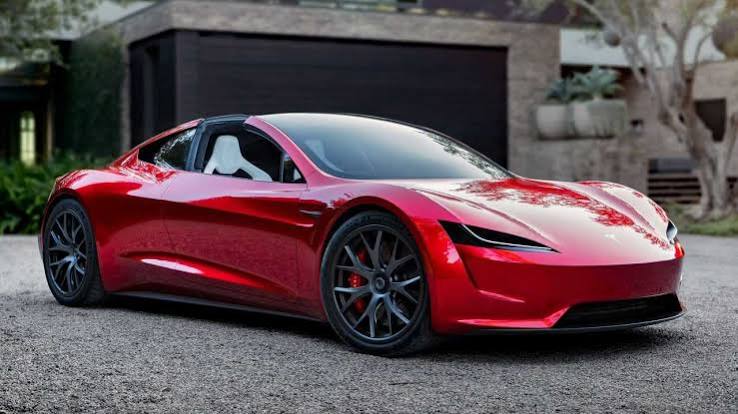
Design and packaging
The 2017 prototype is a low 2+2 coupe with a long hood, short rear deck, and a wraparound glass canopy. Tesla called it the first supercar that could set performance records and still seat four. Rear seats are expected to be small; they may disappear entirely on a SpaceX-package car if tanks and hardware take that space.
Reported production-intent work includes:
- A dedicated performance EV platform (not a Model S derivative)
- Ground-effect / ducted aero ideas Tesla has patented
- Lightweight seats
- Steer-by-wire
- High-power DC charging (figures around 350 kW have been discussed)
How much of the 2017 body survives October 1 is one of the open questions. Executives have said the production car will differ from the old prototype.
Tesla Roadster SpaceX Package: Cold-Gas Thrusters
The most viral claim is not the 1.9-second sprint. It is the optional SpaceX package: roughly 10 cold-gas thrusters fed by high-pressure composite tanks, developed with SpaceX know-how.
How Tesla and reporting describe the system:
- No combustion. Compressed gas (often described as air or cold gas) is dumped through nozzles.
- Tanks are composite overwrapped pressure vessels, in the same family of hardware SpaceX uses on rockets, at very high pressure (figures around 10,000 psi have been cited).
- Rear nozzles would add forward thrust when tires are traction-limited.
- Side and other nozzles are described as aids for cornering, braking, and stability.
- Musk has talked about brief hops or a short lift off the ground.
Claimed acceleration with the package has ranged from about 1.1 seconds to 60 mph to “under one second,” depending on the year and the quote. That is far beyond what street tires can do on pavement alone.
Important caveats:
- The thruster car shown or demoed on October 1 may not be the street-legal customer car.
- Several reports say the full SpaceX version could be limited, track-oriented, or not street legal.
- Hardware, noise, certification, and durability are the reasons this package has slipped for years.
The “Go for launch” teaser Tesla posted in mid-September 2026, with launch-pad lighting and thruster-like plumes, is clearly aimed at this story. Whether customers can buy a flying (or hopping) Roadster is still unconfirmed.
Tesla Roadster Price, Reservations, and Founders Series
In 2017 Tesla published:
- Base price: $200,000
- Founders Series: $250,000, first 1,000 cars, paid in full up front
- Standard reservation: $50,000 deposit
Tesla later removed pricing from the public Roadster page. Reservations have stayed open. Founders Series deposits alone have been estimated in the hundreds of millions of dollars. A price increase at reveal would not be surprising; Tesla did the same with Cybertruck after years of deposits.
Until Tesla republishes a price, the only hard number is the $50,000 reservation still listed in many snapshots of the configurator flow.
Tesla Roadster Release Date: Reveal vs Production
These are not the same event.
| Milestone | Status |
|---|---|
| Concept / prototype reveal | November 16, 2017 |
| Original production target | 2020 |
| Repeated slips | 2021 through 2026 |
| Current public reveal | October 1, 2026, Waco, Texas |
| Production plant | Gigafactory Texas (confirmed by Tesla vehicle engineering leadership) |
| Customer production window | 2027–2028 in recent Tesla comments |
| Customer deliveries | Not confirmed |
October 1 is an unveil. Invitations have gone to reservation holders; reporting puts the event around 8:30 p.m. Eastern, 21+ only, RSVP-limited. Tesla has not said that line-built customer cars start that night.
If you are a 2017 reservation holder, the realistic question after the show is not “when do I pick it up tomorrow?” It is whether Tesla finally freezes design, publishes production specs, and gives a factory timing that survives the next earnings call.
Tesla Roadster vs the Original — and vs Today’s Hyper-EVs
The name is the same. The mission is not.
The 2008 Roadster had to prove EVs could be desirable. Range anxiety, battery chemistry, and supplier contracts were the real bosses. Beating a Porsche Boxster off the line was the marketing hook.
The 2026 Roadster arrives in a world that already has Rimac Nevera, Pininfarina Battista, Lotus Evija, and ultra-fast versions of Tesla’s own Model S Plaid. A 1.9-second 0–60 time is no longer science fiction. A 620-mile four-seat convertible that also runs 250-plus mph still would be, if Tesla can certify it.
That is why the SpaceX package matters to the story even if few buyers ever get it. Without a trick that gasoline and battery cars cannot copy, the Roadster is “just” another extreme EV that took nine extra years.
What to Watch on October 1, 2026
Use the event as a checklist, not a hype reel:
- Are the 1.9s / 250 mph / 620-mile numbers still on the slide?
- Is there a production-intent interior, or another concept cabin?
- Street-legal spec vs demo spec. If the car leaves the ground, ask whether that hardware is optional, track-only, or theater.
- Price. Expect a number. Do not assume it is still $200,000.
- Build location and year. Giga Texas and 2027–28 are the current working answer.
- Reservation conversion. What happens to 2017 deposits if the car is substantially different or more expensive?
Until those answers exist in writing, the Roadster remains the most famous unfinished Tesla.
Tesla Roadster FAQ
When is the new Tesla Roadster coming out?
Tesla will unveil the next-generation Roadster on October 1, 2026. Production and customer deliveries have not been confirmed for that date. Recent comments point to manufacturing in 2027 or 2028.
How fast is the Tesla Roadster?
The original 2008–2012 Roadster did 0–60 mph in about 3.7–3.9 seconds. Tesla claims 1.9 seconds for the new base car and has talked about around one second with the SpaceX thruster package. Only the first figure has been proven in production cars.
What is the Tesla Roadster range?
EPA range for the original car was about 244 miles. Tesla claims 620 miles for the new Roadster from a roughly 200 kWh pack. Test cycle and production battery size are unverified.
How much does a Tesla Roadster cost?
The first-generation car started near $99,000. The second generation was announced at $200,000 (Founders Series $250,000). Tesla later removed public pricing. A new official price is expected at or after the October reveal. A reservation still typically requires a large deposit.
Can the Tesla Roadster fly?
Elon Musk has said thrusters could let the car hop or briefly lift off. Reporting describes cold-gas thrusters, not a licensed aircraft. Whether any customer car will be allowed to do that on public roads is unconfirmed, and some coverage says the demo vehicle may not be street legal.
How many original Tesla Roadsters exist?
Tesla built about 2,450 first-generation Roadsters. Survivors are collector cars. They are not the same vehicle as the 2017 concept.
Where will the new Roadster be built?
Tesla executives have said Gigafactory Texas in Austin. That matches the Waco-area reveal geography.
Bottom Line
The Tesla Roadster is the company’s origin story and its longest-running promise.
The first Roadster already earned its place: first modern lithium-ion sports car with real highway range, built in tiny numbers, and used as the springboard for everything Tesla sold afterward.
The second Roadster is still a claim sheet waiting for a factory. October 1, 2026 is the first date in years that looks like a real public checkpoint. If Tesla shows a frozen design, honest specs, a price, and a production year it can keep, the halo car finally starts. If it shows another prototype and another slogan, the wait simply gets a new trailer.
For searchers comparing “Tesla Roadster specs,” “Tesla Roadster price,” and “Tesla Roadster release date,” the accurate summary in September 2026 is: historic first car, unfinished second car, reveal next month, production still next year or the year after.