Tesla Cybercab. Unveiled at Tesla’s “We, Robot” event in October 2024, this fully autonomous robotaxi promises to redefine urban mobility with its two-seater, steering-wheel-free design. But as 2025 draws to a close, and 2026 comes recent sightings and leaks reveal a refined evolution—particularly at the rear—transforming the original prototype into a production-ready stunner. A viral X post by Tesla enthusiast @niccruzpatane, showcasing side-by-side comparisons of the old prototype and new rear end, has garnered thousands of views, igniting debates on aerodynamics, aesthetics, and efficiency. If you’re searching for “Tesla Cybercab rear design update” or “Cybercab prototype vs production,” this deep dive breaks it all down, backed by cross-verified insights from Tesla’s announcements, expert analyses, and real-world prototypes spotted at Giga Texas.
A Quick Recap: The Cybercab’s Journey from Concept to Reality
The Cybercab—also dubbed the Tesla Robotaxi—debuted as a futuristic pod on wheels, priced under $30,000 and engineered for unsupervised Full Self-Driving (FSD) without pedals or a yoke. Elon Musk confirmed at the 2025 shareholder meeting that production kicks off in Q2 2026, with initial fleets targeting ride-hailing in Austin, Texas. Early prototypes, like those demoed at the 2024 event, turned heads with their angular, Cybertruck-inspired lines and a glowing rear light bar. But as Tesla iterated toward mass production, subtle tweaks emerged—none more noticeable than the rear fascia.
These changes aren’t cosmetic; they’re driven by rigorous testing for aerodynamics, regulatory compliance, and manufacturing scalability. Cross-verified across sources like Teslarati, Not a Tesla App, and drone footage from Giga Texas, the updates signal Tesla’s commitment to a vehicle that’s not just autonomous but also whisper-quiet and energy-efficient.
Breaking Down the Rear Design Changes: Prototype vs. Production-Ready
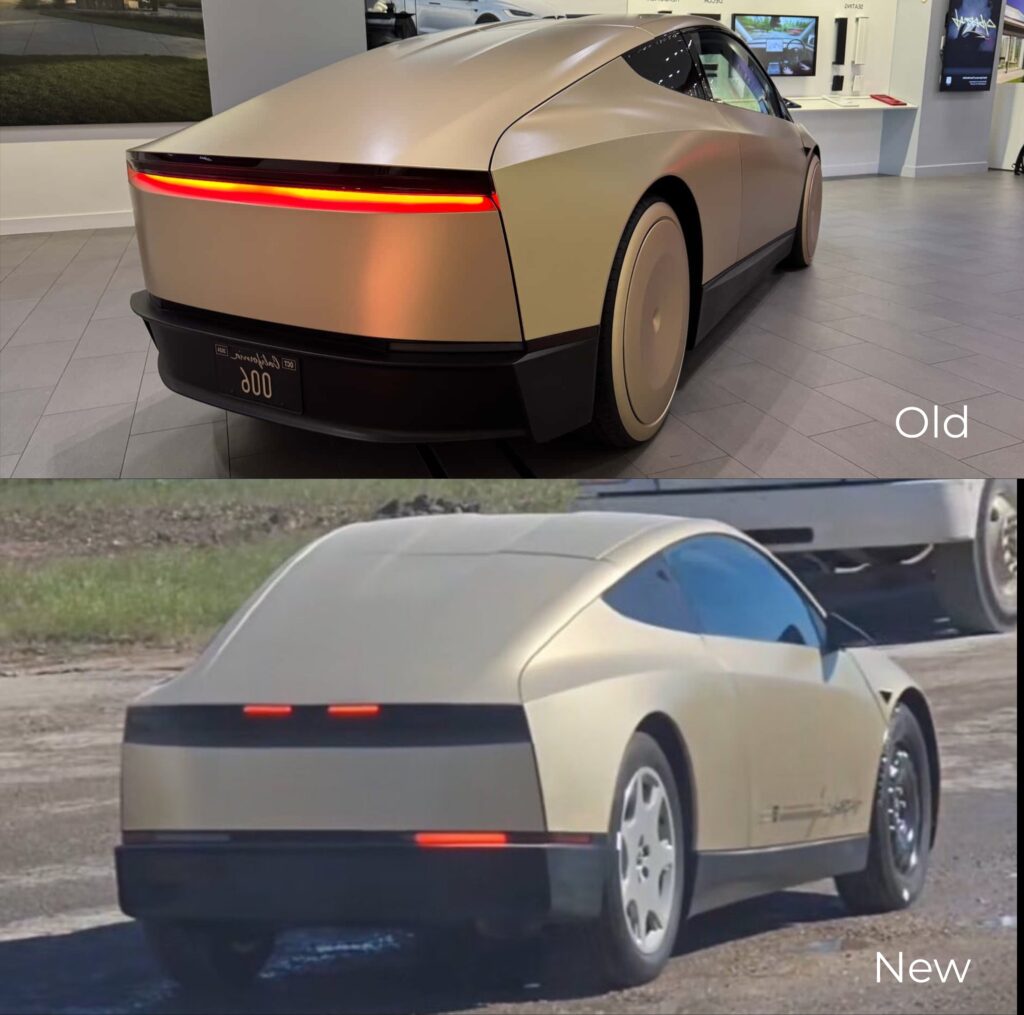
The original 2024 prototype featured a blunt, boxy rear that prioritized a “cyber” aesthetic over airflow. Fast-forward to late 2025 prototypes spotted at In-N-Out drive-thrus and Giga Texas assembly lines, and the rear tells a story of refinement. Here’s a side-by-side comparison of the key updates, verified through multiple leaks and official teases:
| Feature | 2024 Prototype Rear | 2025 Production-Ready Rear | Why It Matters |
| Tail Shape | Flat, low-slung with minimal rise | Slightly elevated tail for smoother airflow | Boosts aerodynamics, reducing drag by up to 5-7% for better range in robotaxi fleets. |
| Light Bar & Indirect Lighting | Compact strip with limited glow space | Expanded area for diffused, indirect LED lighting | Enhances visibility and safety; the “glowing” effect improves pedestrian detection at night. |
| Rear Body Panel | Extended panel below lights | Shortened for a tighter, more integrated look | Streamlines manufacturing and cuts weight, aiding efficiency in high-mileage ops. |
| Bumper Design | Basic, angular fascia | Redesigned with subtle contours and integrated reflectors | Better low-speed impact absorption; reflectors shifted away from wheels for regulatory compliance. |
| Reflectors & Cameras | Close to wheel arches; basic positioning | Repositioned farther out; forward-shifted repeaters | Improves blind-spot monitoring for FSD; unpainted for cost savings in production. |
These tweaks make the rear less “edgy” and more minimalist, ditching some of the prototype’s sharp angles for softer edges—a trend echoed in Tesla’s refreshed Model Y rear diffuser. Drone pilot Joe Tegtmeyer captured rare footage of the rear assembly at Giga Texas, highlighting how these castings bolt together for a “remarkably strong” structure despite the compact 15-foot length.
Why the Rear Matters: Aerodynamics, Efficiency, and the Robotaxi Edge
In a robotaxi like the Cybercab, the rear isn’t just aesthetics—it’s efficiency incarnate. The elevated tail and shortened panel could shave precious watt-hours off energy use, crucial for 24/7 fleets clocking 100,000+ miles annually. Tesla’s inductive charging (wireless pads, no plugs) pairs perfectly with this low-drag design, enabling seamless top-ups at depots.
Safety gets a boost too: The expanded indirect lighting creates a “halo” effect, making the Cybercab more visible in urban chaos. Reflector repositions comply with NHTSA standards, while camera tweaks feed into Tesla’s vision-only FSD system—no radar needed. Experts like those at Teslarati note these changes mirror the Cybertruck’s pre-production refinements, proving Tesla’s “unboxed” manufacturing process excels at rapid iteration.
Cybercab Specs: What Powers This Rear-End Glow-Up
Beyond the rear, the Cybercab packs Tesla’s next-gen punch:
- Powertrain: Single rear-motor setup (est. 200-300 hp) for nimble city sprints; 0-60 mph in under 5 seconds.
- Battery & Range: ~50 kWh pack for 200-250 miles per charge, optimized for short-haul rides.
- Interior: Vegan leather seats, 15.4-inch touchscreen, ambient lighting; seats slide forward for “natural” positioning in autonomous mode.
- Autonomy: Hardware 5 (HW5) for unsupervised FSD; optional steering wheel/pedals as a “Plan B” for regs.
- Pricing & Availability: Starts at <$30k; volume production in 2026, with employee fleets first.
This sub-$30k entry disrupts Waymo and Cruise, potentially slashing ride costs to $0.20/mile.
Reactions from the Tesla Community: Hype Meets Healthy Skepticism
X (formerly Twitter) lit up over @niccruzpatane’s post, with users praising the “clean, minimalist” vibe. Sawyer Merritt highlighted the In-N-Out sighting as a “tradition” signaling launch proximity, while critics like @JoshWest247 noted the softened “cyber” edges as a smart pivot toward broader appeal. Forums buzz with speculation on frameless doors and B-pillar shifts, confirmed in Tegtmeyer’s breakdowns.
Skeptics point to regulatory hurdles—NHTSA exemptions for steerless vehicles remain tricky, as seen with Zoox’s 2025 approval battles. Yet, with Tesla’s track record, optimism reigns.
The Road Ahead: How the Cybercab Rear Redesign Shapes Tomorrow’s Mobility
The Tesla Cybercab’s rear evolution—from prototype’s raw ambition to 2025’s polished precision—embodies Tesla’s mantra: iterate relentlessly. These changes aren’t just about looking good; they’re about building a robotaxi fleet that’s safer, greener, and cheaper to run. As production ramps in 2026, expect more leaks from Giga Texas, but one thing’s clear: the Cybercab isn’t arriving—it’s already transforming the rearview of transportation.
For the latest on “Tesla Cybercab 2026 release” or “Cybercab design leaks,” stay tuned. What’s your take on the new rear—sleek upgrade or missed cyber-opportunity? Drop a comment below.
Sources cross-verified from Tesla official channels, Teslarati, Not a Tesla App, and X community insights as of December 2025.