Tesla has just announced a groundbreaking achievement: over 10 billion miles driven on Full Self-Driving (FSD) Supervised. This massive milestone, shared directly by Tesla on X, underscores the rapid progress in AI-powered autonomous driving and positions the company as a clear leader in the race toward fully self-driving vehicles.
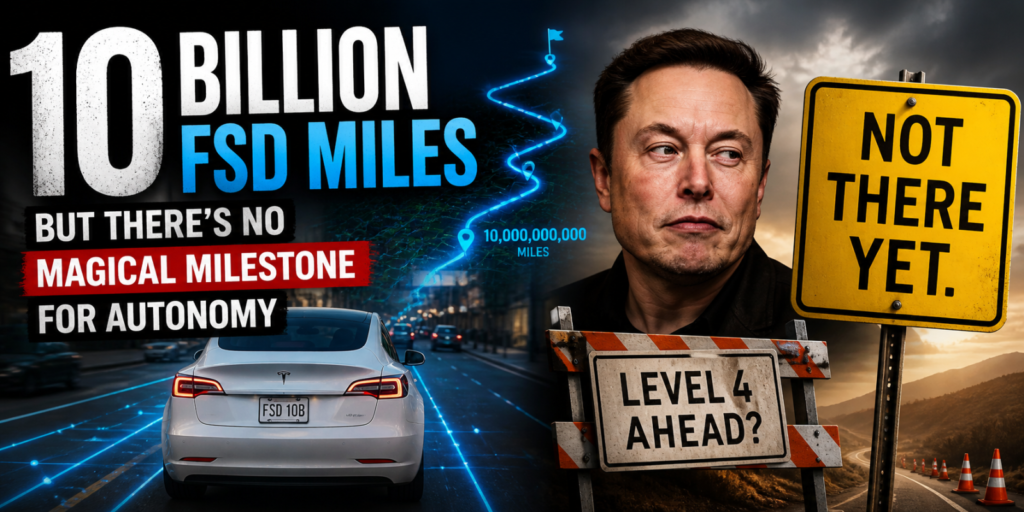
As of the latest data from Tesla’s official FSD Safety Report, the exact figure stands at 10,004,433,661 miles (with approximately 3.76 billion city miles driven). This isn’t just a number — it represents an enormous real-world dataset that powers Tesla’s neural networks and accelerates the path to unsupervised autonomy.
What Is Tesla FSD Supervised?
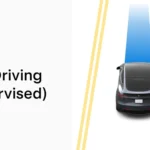
Tesla’s Full Self-Driving (FSD) Supervised is an advanced driver-assistance system that uses cameras, AI, and end-to-end neural networks to handle steering, acceleration, braking, lane changes, and complex urban navigation — all while requiring active driver supervision. Unlike traditional ADAS systems, FSD learns continuously from millions of Tesla vehicles on the road.
Available in select markets (U.S., Canada, Mexico, Australia, and others via over-the-air updates), FSD Supervised turns every Tesla drive into valuable training data for the entire fleet.
Why 10 Billion Miles Matters: The Data Advantage
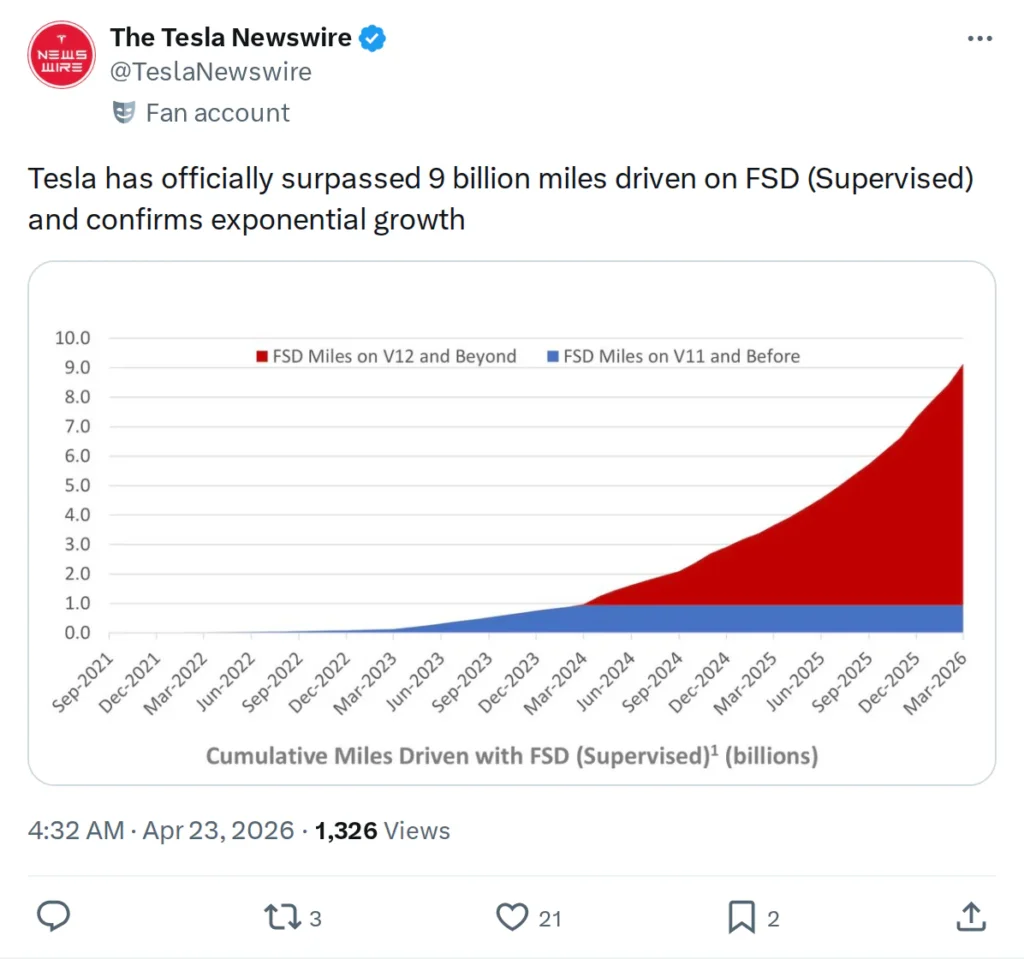
Tesla’s fleet has now logged more than 10 billion miles on FSD Supervised since 2020. This exponential growth (shown in recent fleet data charts) gives Tesla an unmatched advantage in machine learning.
- Real-world variety: Every weather condition, road type, city street, and unexpected scenario feeds the AI.
- No simulated data reliance: Unlike competitors, Tesla trains primarily on actual human-like driving environments.
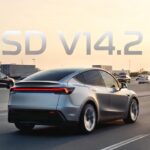
- Rapid iteration: New versions of FSD (like V14.x) improve weekly thanks to this data flood.
Elon Musk previously noted that roughly 10 billion miles of training data would be a key threshold for achieving safe unsupervised self-driving. This milestone directly hits that benchmark, sparking excitement about the imminent arrival of true robotaxi capability.
Impressive Safety Statistics from Tesla’s Latest Report
Tesla’s FSD Safety Report (updated quarterly) reveals compelling safety gains:
- 7x fewer major collisions compared to the U.S. average
- 7x fewer minor collisions vs. U.S. average
- 5x fewer off-highway collisions
- Overall, FSD Supervised improves U.S. road safety by over 80% by reducing human-error crashes
Tesla estimates that scaling this technology could prevent 32,000+ fatalities and 1.9 million injuries annually in the U.S. alone — numbers aligned with NHTSA 2023 data on drunk driving (30%), speeding (29%), distracted driving (29%), and seatbelt non-use (44% of occupant fatalities).
These figures come from anonymised telemetry data across the connected Tesla fleet (excluding China) and compare FSD-engaged miles directly against manually driven Tesla vehicles and older U.S. fleet averages.
How Tesla FSD Compares to Competitors and Human Drivers
Most automakers still rely on expensive lidar/radar sensor suites and limited test fleets. Tesla’s vision-only approach + billions of real-world miles gives it a unique edge:
- Competitors’ robotaxis often operate in geofenced areas with safety drivers.
- Tesla’s system works nationwide on consumer vehicles with zero added hardware cost for newer models.
- Crash rates are measured objectively (airbag deployment or significant Delta-V events) — and FSD consistently outperforms both human drivers and Tesla vehicles driven without FSD.
What This Means for the Future: Robotaxi, Cybercab, and Beyond
Reaching 10 billion FSD Supervised miles is widely seen as the final major data-gathering step before unsupervised FSD (and robotaxi deployment). Tesla owners are already experiencing near-autonomous drives, and the company’s upcoming Cybercab and Robovan concepts will build directly on this foundation.
Benefits for drivers and society include:
- Dramatically lower accident rates
- Reduced traffic congestion
- New mobility options (e.g., robotaxi fleets)
- Lower insurance costs over time
Tesla Owners: How to Contribute and Benefit
Every mile you drive with FSD Supervised helps train the next version. Owners report that the latest software updates feel smoother, more confident, and capable in complex situations than ever before.
Ready to experience it? Tesla offers FSD as a one-time purchase or an affordable monthly subscription. Check availability in your region via the Tesla app or website.
The Road Ahead: 2026 and Unsupervised Autonomy
Tesla’s 10 billion mile milestone isn’t the end — it’s the beginning of the unsupervised era. With data growing exponentially, expect rapid progress toward fully autonomous vehicles that require no human supervision.
This achievement reinforces Tesla’s position at the forefront of AI, robotics, and sustainable transportation. As the company likes to say: the future is electric — and increasingly autonomous.
What do you think? Have you tried FSD Supervised yet? Share your experiences in the comments. For the latest Tesla FSD updates, safety reports, and robotaxi news, bookmark this page and follow along.
Data sourced from Tesla’s official FSD Safety Report (May 2026). FSD Supervised requires active driver attention and is not yet fully autonomous. Always follow local laws and vehicle manuals.
Stay tuned — the next 10 billion miles are coming faster than you think! 🚀