Introduction: The Day the Steering Wheel Started to Disappear
On June 30, 2026, Tesla posted a short but historic video on X with the caption:
“Engineering tests of the first production Cybercab have begun in Austin.”
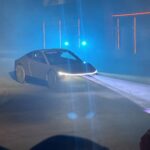
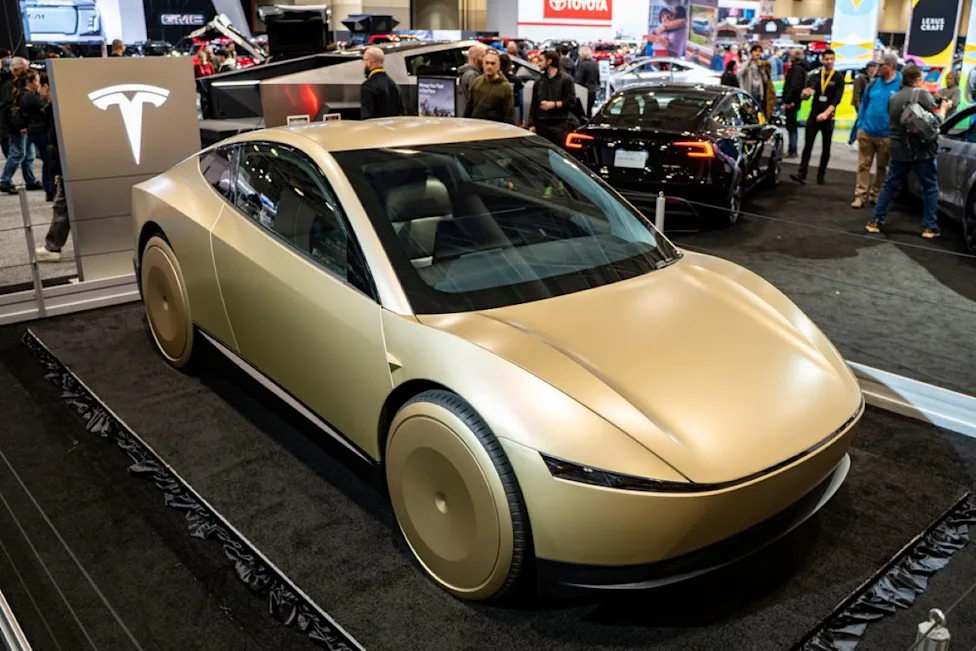
The 27-second clip shows a sleek, gold-colored, two-seater vehicle with no steering wheel and no pedals smoothly navigating real Austin city streets. A safety monitor sits in the right-front passenger seat — because there is no driver’s seat in the traditional sense.
This is not another prototype sighting. These are customer-spec production vehicles rolling out of Gigafactory Texas and now being validated on public roads. It represents one of the clearest signals yet that Tesla is serious about building a purpose-built, low-cost, fully autonomous robotaxi at scale.
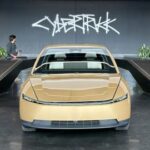
For context, Tesla first unveiled the Cybercab concept on October 10, 2024, at the “We, Robot” event. Less than 20 months later, production units without any manual controls are on public roads. This article breaks down exactly what happened, why it matters, the technology behind it, the regulatory hurdles, the economics, the competitive landscape, risks, and what it could mean for the future of transportation — including potential ripple effects in markets like India.
Complete Timeline: From Concept to Public Road Testing
| Date | Milestone | Details |
|---|---|---|
| Oct 10, 2024 | Cybercab Unveiled at We, Robot event | Two-seater, no steering wheel/pedals shown, ~$30k target price |
| Late 2025 | Engineering prototypes with temporary controls spotted | Removable steering wheels & pedals added for testing & regulations |
| Feb 17, 2026 | First production Cybercab rolls off Gigafactory Texas line | Official confirmation of production start |
| Jan–June 2026 | Unsupervised robotaxi service using modified Model Y vehicles in Austin | Tesla already operating limited driverless rides in geofenced areas |
| June 30, 2026 | Production Cybercab (no controls) begins public road engineering tests | Official Tesla announcement + video |
This rapid progression from concept (2024) → first production unit (Feb 2026) → public road testing without controls (June 2026) shows Tesla accelerating its autonomy timeline despite historical delays.
Technical Deep Dive: Why No Steering Wheel or Pedals Matters
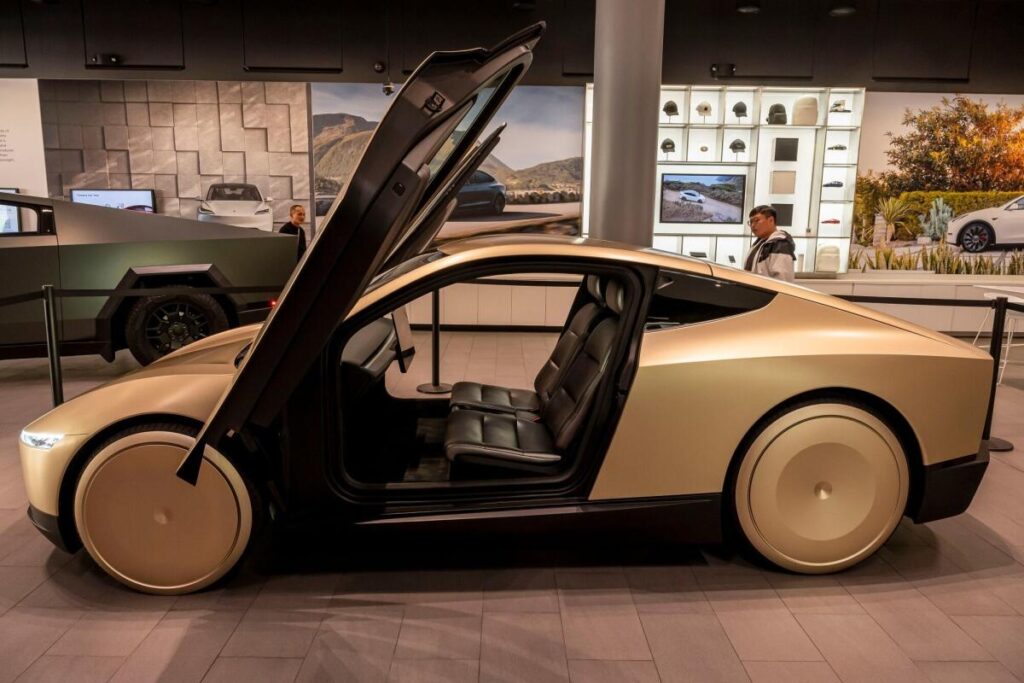
The Cybercab is not a modified existing Tesla. It is a ground-up design optimised exclusively for autonomous ride-hailing:
- No steering wheel or pedals — Reduces parts count, weight, cost, and potential failure points. Also eliminates one of the biggest sources of injury in crashes (steering wheel impact).
- Two front-facing passenger seats — Both occupants are treated equally; there is no “driver” position.
- Large central touchscreen + rear screen — For entertainment, trip information, and future video calls or productivity.
- Tesla Vision-only autonomy — Relies entirely on cameras + neural networks (no lidar). This approach has been controversial but allows dramatically lower hardware cost.
- Unboxed manufacturing process — Tesla claims this new production method (inspired by but improved over Cybertruck) will enable very high volume at low cost.
- Target price: ~$30,000 — Elon Musk has publicly bet the vehicle will be sold below this price before 2027.
The safety monitor currently present is there for engineering data collection and regulatory compliance during this validation phase. Once Tesla proves the system is safe enough, these monitors are expected to be removed.
The Video: What We Actually Saw
The official Tesla video shows the Cybercab driving normally through Austin traffic. Key observations from analysts and viewers:
- Smooth acceleration, braking, and lane changes
- Proper handling of intersections and other vehicles
- No visible human intervention
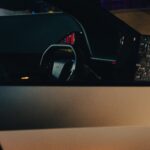
- The interior looks production-ready with ambient lighting and a clean, minimalist design
- License plates appear to be regular Texas plates (not manufacturer/test plates), suggesting these are treated as normal vehicles
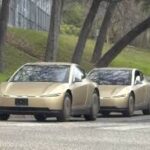
This is a significant step beyond the earlier sightings of Cybercabs with temporary steering wheels.
Regulatory Context: Texas Leads the Way
Texas has some of the most AV-friendly regulations in the United States. The fact that the Texas Department of Transportation has allowed production vehicles without any manual controls on public roads is a major regulatory win for Tesla.
Key points:
- Test vehicles previously used removable steering wheels to satisfy regulators during validation.
- Once sufficient data is collected, the controls are removed permanently.
- This sets a precedent. Other states (and potentially the federal NHTSA) will now have a real-world example to evaluate.
- Contrast with California and Arizona, where Waymo operates but often under stricter human oversight rules in certain zones.
Tesla is effectively forcing regulators to confront the question: “If the car has no steering wheel, what does ‘human control’ even mean?”
Robotaxi Economics: The Real Game-Changer
This is where the Cybercab story becomes truly disruptive.
Tesla’s thesis:
- Vehicle cost: ~$30,000 (vs $150k–$200k+ for many lidar-based robotaxis)
- High utilisation: Potentially 20–24 hours/day
- Low operating cost (electricity + maintenance vs human drivers)
- Projected annual profit per vehicle: Some analysts and community estimates range from $15,000–$30,000+ once scaled
If Tesla can achieve even a fraction of these numbers, the robotaxi business could become one of the highest-margin operations in the automotive or technology sector.
Compare this to current ride-hailing: Uber and Lyft take significant cuts, and human drivers are the highest cost. A $30k autonomous vehicle operating 20+ hours/day changes the entire cost structure.
Tesla has also said existing Tesla owners will eventually be able to add their vehicles to the robotaxi network (with hardware/software requirements), creating a hybrid model of company-owned Cybercab fleets + owner participation.
Competitive Landscape: Tesla vs Waymo and the Rest
| Factor | Tesla Cybercab | Waymo (Alphabet) | Zoox (Amazon) | Chinese AVs (Baidu, Pony.ai) |
|---|---|---|---|---|
| Vehicle Cost | ~$30k target | Much higher | Higher | Varies |
| Controls | None (production) | Traditional + driverless mode | No steering wheel | Mostly traditional |
| Current Deployment | Engineering tests (June 2026) | Paid service in multiple cities | Limited (Las Vegas) | Strong in China |
| Tech Approach | Vision-only + AI | Lidar + cameras + HD maps | Lidar-heavy | Mixed |
| Scale Ambition | Millions of vehicles | Slower, more expensive expansion | Limited | Government-backed scale |
| Data Advantage | Billions of miles from customer cars | Strong but smaller fleet | Smaller | Large in home market |
Current reality check: As of mid-2026, Waymo actually has more real-world paid autonomous miles and operating cities than Tesla’s Cybercab program. Tesla is betting that its lower cost + software updates + massive data from existing customer cars will allow it to catch up and overtake on scale.
India Perspective: What This Could Mean for Emerging Markets
While Cybercab testing is happening in Texas, the implications are global — including for India.
Potential relevance for India:
- Indian cities suffer from high traffic density, pollution, and expensive last-mile connectivity.
- A low-cost (~$30k) autonomous pod could theoretically offer affordable, clean ride-hailing at scale.
- However, India currently has no comprehensive regulatory framework for Level 4/5 autonomous vehicles.
- Tesla has been in long-running discussions about entering India (manufacturing or imports). A successful Cybercab program in the US could accelerate Tesla’s India strategy.
- Smart city initiatives in places like Mumbai, Delhi-NCR, Bengaluru, and Hyderabad could eventually become testbeds.
Challenges in India:
- Regulatory approval would likely take years.
- Infrastructure (charging, 5G/edge computing, mapping) needs massive upgrades.
- Public trust and job displacement concerns (millions of drivers) would be politically sensitive.
- Data privacy and cybersecurity rules are still evolving.
For now, the Cybercab remains a US-first story, but successful scaling in Texas could become a powerful case study for regulators worldwide.
Risks, Criticisms, and Realistic Challenges
Despite the excitement, several significant risks remain:
- Timeline Overpromising — Tesla has a history of optimistic autonomy deadlines.
- Regulatory Approval — Getting full approval for vehicles with zero manual controls across multiple states/countries is non-trivial.
- Safety & Public Trust — One major incident could set the industry back years.
- Competition — Waymo is already operating paid services. Chinese companies have strong government support at home.
- Insurance & Liability — Who is responsible when there is no human driver?
- Scaling Manufacturing — Unboxed process is new; real-world ramp-up could face teething issues.
- Geofencing vs True Autonomy — Current unsupervised rides in Austin are still limited to certain areas.
Future Outlook & Predicted Timeline (with Caveats)
| Milestone | Most Likely Window | Confidence |
|---|---|---|
| Wider unsupervised testing (Texas) | Late 2026 | Medium |
| First paid Cybercab rides (limited) | 2027 | Medium |
| Significant fleet deployment | 2027–2028 | Medium |
| National (US) expansion | 2028+ | Lower |
| International markets (incl. India) | 2029+ | Low |
Tesla’s advantage is vertical integration (vehicle + software + energy + potential insurance + app). If they execute well, they could dominate the robotaxi space on cost and scale.
Expanded FAQ
Q: Are these Cybercabs already giving paid rides to the public?
A: No. These are engineering tests only. Tesla’s current unsupervised robotaxi service in Austin still uses modified Model Y vehicles.
Q: When will the steering wheel and pedals be completely removed from all test vehicles?
A: They already are on these production units. Earlier test cars had removable controls for regulatory reasons during validation.
Q: How does Tesla’s vision-only system compare to Waymo’s lidar approach?
A: Tesla argues cameras + AI are sufficient and far cheaper to scale. Waymo’s multi-sensor approach is more conservative and currently more proven in limited deployments.
Q: Will I be able to buy a Cybercab for personal use?
A: Tesla has indicated the vehicle is primarily designed for robotaxi fleets, but Elon Musk has said private ownership may eventually be possible.
Q: What happens to Uber and Lyft drivers if robotaxis succeed?
A: Significant disruption is expected. Historical precedent (e.g., ride-hailing itself) shows new jobs are created even as old ones decline, but the transition can be painful.