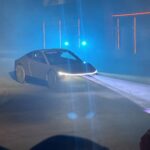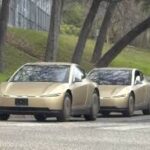
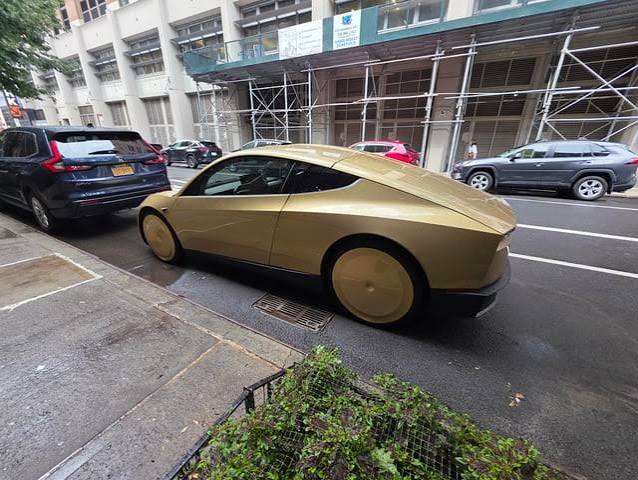
Tesla’s purpose-built robotaxi, the Cybercab, has made its first confirmed appearance driving on the streets of Midtown Manhattan. Videos and photos captured on August 24, 2026, show an engineering vehicle navigating busy New York City traffic near 57th Street and Park Avenue early in the morning, with additional sightings reported in other parts of the city including Queens.
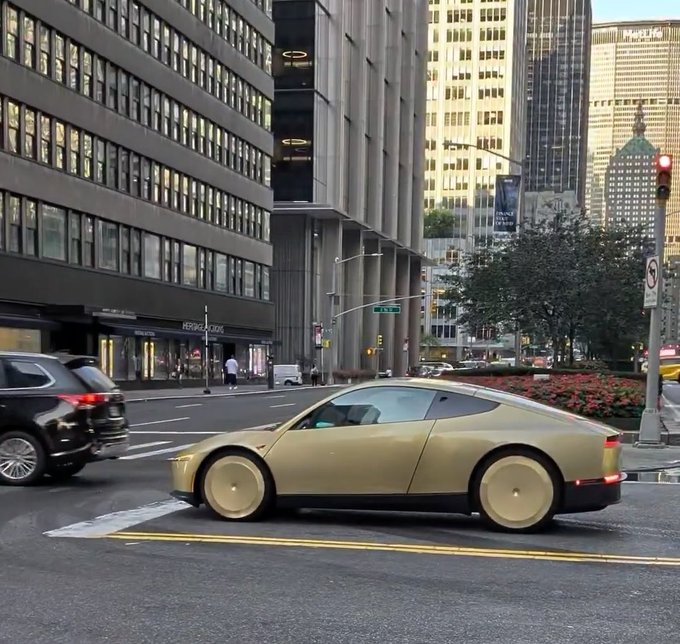
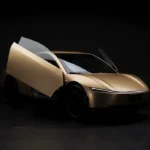
The gold-colored two-seater — instantly recognizable by its covered wheels, sleek coupe-like profile, and absence of traditional driver controls — was filmed by local Tesla enthusiasts and shared widely. This marks a notable expansion of real-world testing beyond Tesla’s primary hubs in Texas and California, coming just days before the company’s planned Cybercab launch event in Austin on September 3, 2026.
What Was Spotted in New York City
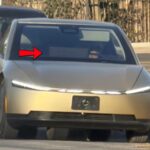
The vehicle seen in Midtown is described as an engineering prototype or test unit rather than a production robotaxi carrying passengers. It features Texas plates in some clips and matches the distinctive Cybercab design first revealed in late 2024: a compact, aerodynamic body with scissor-style doors, wheel covers that give it a futuristic look, and no visible steering wheel or pedals in the production configuration.
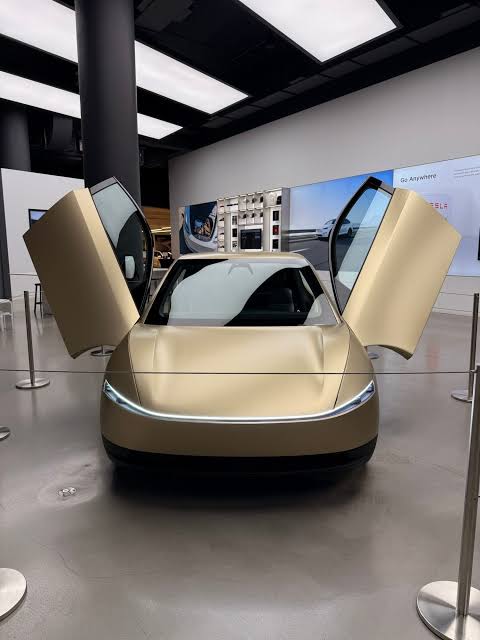
Earlier reports had placed Cybercabs in Queens, but the Midtown Manhattan footage represents the first widely confirmed driving activity in the densest part of the city. The timing is significant — Tesla has been conducting engineering validation on public roads since June 2026, after production of the first units began at Gigafactory Texas earlier in the year.
Cybercab Specs and Design Focus
According to EPA certification documents released in 2026, the Cybercab prioritizes efficiency and high utilization for ride-hailing rather than personal performance:
- Single front-mounted permanent-magnet motor producing 219 hp (163 kW)
- Front-wheel-drive layout (a first for a production Tesla)
- Approximately 47.6–48 kWh lithium-ion battery pack
- Curb weight of 3,113 lbs (1,412 kg)
- Unadjusted EPA test range of about 418 miles, translating to roughly 293 miles under standard real-world adjustment factors
- Class-leading efficiency around 165 Wh/mi
The design eliminates the steering wheel and pedals entirely for the production robotaxi version, relying on Tesla’s Full Self-Driving software. Some earlier test units temporarily carried steering hardware for engineering purposes. The lightweight construction, small battery, and efficiency focus are intentional: the Cybercab is built to maximize fleet utilization and minimize operating costs in autonomous ride-hailing service.
Why the NYC Sighting Matters
New York City remains one of the most challenging environments for autonomous vehicles in the United States. State and city rules generally require a licensed safety driver for testing, and commercial unsupervised robotaxi operations face significant regulatory and political hurdles through the Taxi and Limousine Commission (TLC) and related legislation. Previous attempts to expand commercial AV services in New York have faced delays or scaled-back proposals.
Tesla’s decision to run Cybercab engineering vehicles through Manhattan traffic therefore serves multiple purposes: gathering data in dense urban conditions with complex intersections, pedestrians, construction, and aggressive driving; validating systems under real-world East Coast conditions; and generating public visibility ahead of the Austin launch.
Tesla’s existing Robotaxi service (currently using Model Y vehicles) operates in Austin and select other cities with unsupervised capability in Texas. The Cybercab is intended to become the high-volume workhorse of that fleet over time. Reports indicate Tesla planned to begin with employee rides on public roads in Austin, followed by integration into the paid Robotaxi service, with a formal launch event scheduled for September 3, 2026.
Broader Context and Timeline
Production of the Cybercab began at Gigafactory Texas in early 2026. Units have already been tested in multiple states, including cold-weather validation in places like Buffalo, New York, earlier in the year. The vehicle is designed for high utilization, wireless inductive charging in many scenarios, and remote monitoring/support as needed.
While the Midtown sighting does not mean commercial Cybercab rides are coming to New York City soon, it demonstrates Tesla’s willingness to push real-world validation into one of the world’s most demanding urban environments. Regulatory pathways in New York remain more restrictive than in Texas, so any future deployment would require additional approvals.
For Tesla investors, enthusiasts, and the broader EV community, the Manhattan footage is another concrete data point showing the Cybercab moving from factory and controlled testing into the chaos of everyday city streets — exactly the conditions a robotaxi must master.
The gold Cybercab turning through Midtown traffic is a striking visual. Whether it signals accelerated testing, data collection for FSD improvements, or simply engineering validation, one thing is clear: Tesla’s purpose-built autonomous vehicle is no longer confined to Texas roads.