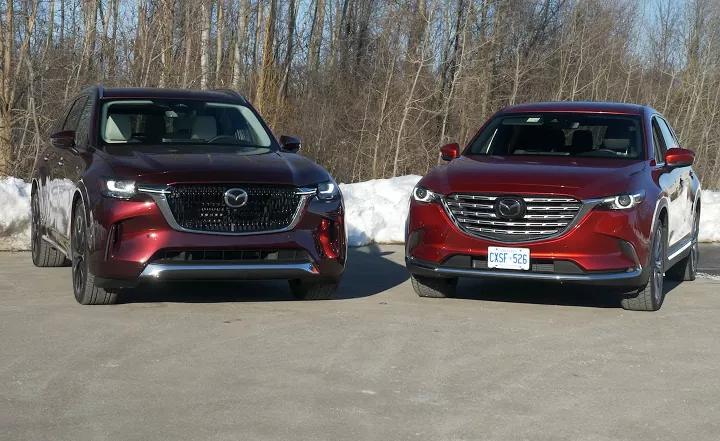
Mazda is replacing the CX-9 with the all-new CX-90 three-row SUV, and if you’re shopping for a family-friendly midsize crossover in 2026, this is the comparison you need. The CX-9 has been a longtime favourite for its sharp handling and upscale feel, but the CX-90 brings more power, better efficiency, extra space, and modern design while keeping the starting price nearly identical.
In this Mazda CX-9 vs CX-90 specs showdown, we break down every major difference—dimensions, engines, performance, fuel economy, interior space, features, safety, and pricing—so you can decide which Mazda three-row SUV fits your needs.
Exterior Design and Dimensions: CX-90 Is Bigger and More Modern
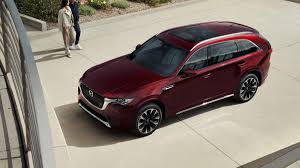
The CX-90 is noticeably larger than the outgoing CX-9 in every dimension, giving it a more commanding road presence without feeling oversized for daily driving.
- Length, Width, and Height: The CX-90 stretches longer, wider, and taller than the CX-9, creating a more muscular and contemporary silhouette.
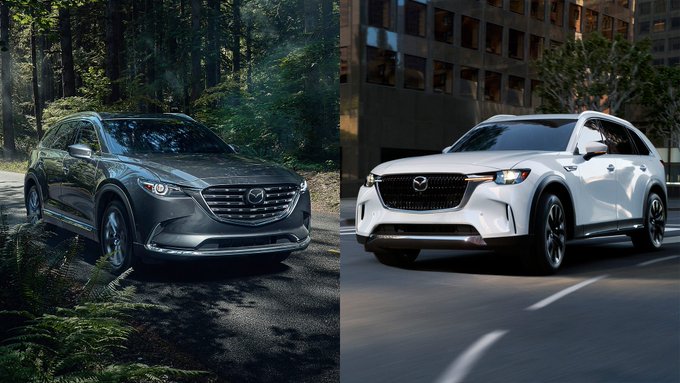
- Styling: The CX-90 features sleek, sculpted lines and a premium “SUV-coupe” inspired profile that looks fresh and upscale. The CX-9’s design, while still attractive, shows its age after nearly two decades on the market.
If you want a three-row SUV that turns heads in the school pickup line or on weekend road trips, the CX-90’s updated look wins hands down.
Engine Options and Performance: More Power and a PHEV Choice
This is where the CX-90 pulls ahead dramatically.
2023 Mazda CX-9
- 2.5-liter turbocharged four-cylinder engine
- 227 hp / 310 lb-ft (regular fuel) or 250 hp / 320 lb-ft (premium fuel)
- 6-speed automatic transmission
- Standard all-wheel drive (AWD)
- 0-60 mph: approximately 7.2 seconds
2024-2025 Mazda CX-90
- 3.3L Turbo Inline-Six (base): 280 hp / 332 lb-ft on regular fuel
- 3.3L Turbo S: 340 hp / 369 lb-ft on premium fuel
- 8-speed automatic transmission
- Standard AWD
- 0-60 mph: as quick as 6.5 seconds (Turbo S model)
- New PHEV Option: 2.5L four-cylinder + electric motor = 323 hp / 369 lb-ft with a 17.8-kWh battery for short all-electric trips
The CX-90’s inline-six engines deliver smoother power delivery and noticeably quicker acceleration than the CX-9’s four-cylinder. The plug-in hybrid (PHEV) version adds electric-only capability that the CX-9 never offered, making the CX-90 far more versatile for eco-conscious families.
Fuel Economy: CX-90 Is More Efficient
The CX-90 improves on the CX-9 across the board:
- CX-9: 20 city / 26 highway mpg
- CX-90 (gasoline): 23-24 city / 28 highway mpg
- CX-90 PHEV: expected to lead the segment in combined efficiency
Better mileage means lower ownership costs and fewer stops at the pump—especially valuable for three-row SUV buyers who often drive long distances.
Interior Space, Cargo, and Comfort
The CX-90 gives families more breathing room:
- Additional legroom in the first and third rows (+0.7 inches)
- +3 cubic feet of cargo space with seats folded
- Premium materials and a more luxurious cabin design throughout
Both SUVs seat seven (or eight in some configurations), but the CX-90 feels roomier and more upscale. Third-row access is still not class-leading, but it’s improved over the CX-9. Cargo volume beats the CX-9, though it still trails some rivals when all seats are up.
Technology and Features: CX-90 Comes Better Equipped
Mazda stepped up the tech game in the CX-90:
- Standard 7.0-inch digital instrument cluster and 10.3-inch infotainment (upgradable to 12.3-inch screens)
- Wireless Apple CarPlay and Android Auto on higher trims
- Wireless phone charging
- Available 12-speaker Bose audio system
- Extra USB-C ports and climate controls for third-row passengers
The CX-9 offered solid tech for its time, but the CX-90 brings it into 2026 with bigger screens, more standard equipment, and a more modern user interface.
Safety Ratings and Driver-Assistance Features
Both models offer excellent safety suites, including adaptive cruise control, automatic emergency braking, blind-spot monitoring, and lane-keeping assist.
- CX-9 earned strong NHTSA five-star overall ratings and IIHS Top Safety Pick status (with one noted weakness in updated crash tests).
- The CX-90 carries over most of the same proven safety tech but has not yet received full crash-test ratings as a brand-new model.
Pricing and Value: Nearly Identical Starting Points
- CX-9 (2023): Started around $40,124
- CX-90 (2024-2025): Starts at approximately $40,970
For just a few hundred dollars more, the CX-90 delivers more power, better efficiency, extra space, and newer technology. Most reviewers agree it offers significantly better overall value and is the clear upgrade.
Mazda CX-9 vs CX-90 Key Specs at a Glance
| Category | 2023 Mazda CX-9 | 2024-2025 Mazda CX-90 |
|---|---|---|
| Engine | 2.5L turbo 4-cyl (227-250 hp) | 3.3L turbo I6 (280-340 hp) + PHEV option |
| Transmission | 6-speed automatic | 8-speed automatic |
| 0-60 mph | ~7.2 seconds | ~6.5 seconds (Turbo S) |
| Fuel Economy | 20/26 mpg | 23-24/28 mpg (gas) |
| Dimensions | Smaller overall | Longer, wider, taller |
| Cargo Space | Less than CX-90 | +3 cu ft with seats folded |
| Starting Price | ~$40,124 | ~$40,970 |
Which Mazda SUV Should You Buy?
If you can find a leftover 2023 CX-9 at a discount, it remains a capable and fun-to-drive three-row SUV. However, for most buyers, the CX-90 is the smarter long-term choice. It brings more power, better fuel economy, a plug-in hybrid option, extra interior room, and fresher styling—all for virtually the same money.
Mazda’s decision to replace the CX-9 with the CX-90 marks the beginning of a new chapter for the brand’s three-row SUV lineup. The CX-90 proves Mazda can deliver premium performance, efficiency, and family-friendly practicality in one polished package.
Ready to upgrade? Test drive both models back-to-back and feel the difference yourself. The CX-90 is here to stay—and it’s raising the bar for every three-row SUV in its class.