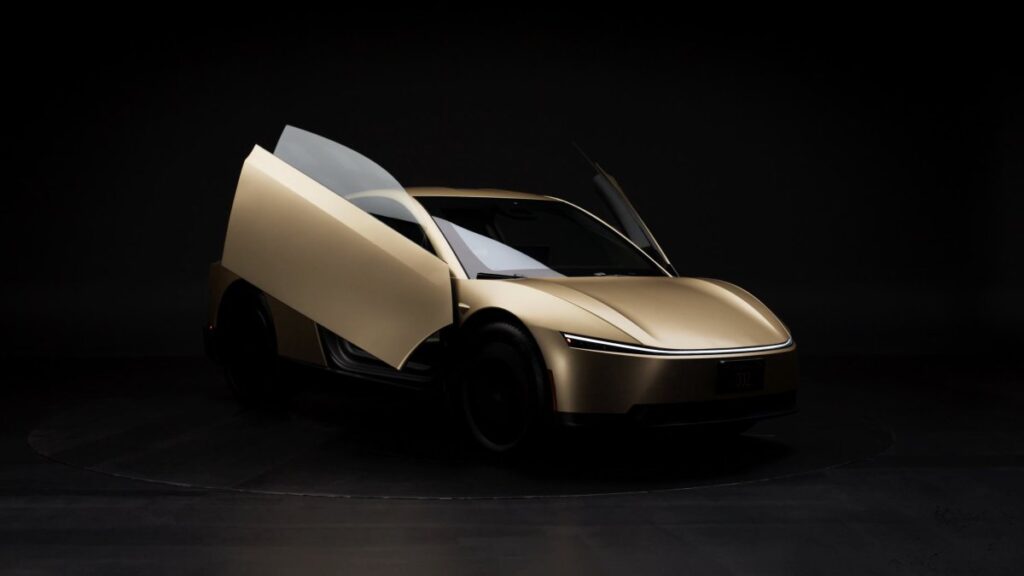
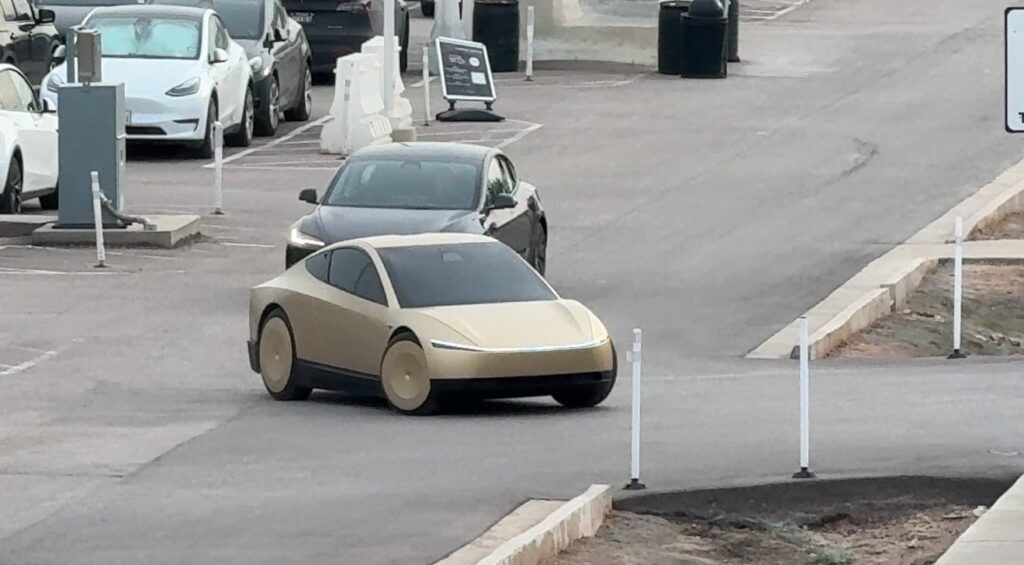
Tesla’s groundbreaking Cybercab robotaxi has just taken another leap toward revolutionising autonomous transportation. On May 28, 2026, Elon Musk shared stunning footage on X (formerly Twitter) showing a sleek gold Cybercab autonomously driving itself straight out of the Giga Texas factory. No driver. No steering wheel. Pure self-driving brilliance.
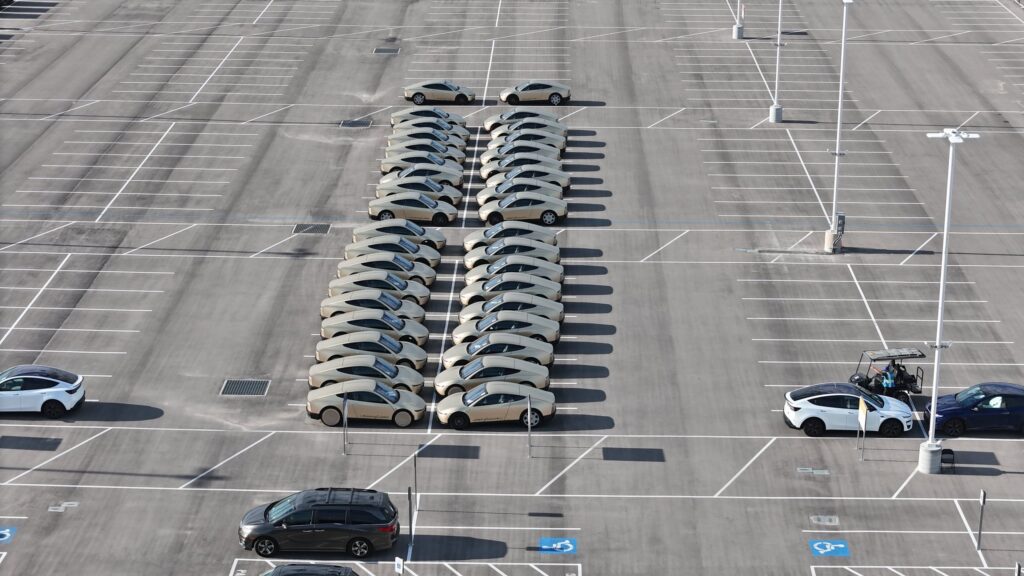
This viral video — which has already racked up millions of views — highlights Tesla’s rapid progress in scaling Cybercab production and validating its Full Self-Driving (FSD) technology right on the factory floor.
What Is the Tesla Cybercab? A Purpose-Built Robotaxi
Unveiled in October 2024, the Tesla Cybercab is a two-seater, fully autonomous vehicle designed exclusively for robotaxi service. Unlike traditional cars, it has:
- No steering wheel
- No pedals
- No human controls
It relies entirely on Tesla’s advanced FSD software, AI, and a suite of cameras and sensors for navigation. Priced under $30,000 at launch (with operating costs as low as $0.20 per mile), the Cybercab aims to make ride-hailing cheaper, safer, and more accessible than ever before.
Key features include:
- Sleek, futuristic design with gull-wing doors
- Wireless charging capability
- High-efficiency electric powertrain
- Integration with Tesla’s upcoming robotaxi network
The Historic Moment: Cybercab Self-Drives Out of Giga Texas
In the video posted by Elon Musk, the Cybercab emerges smoothly from the factory bay at Giga Texas (Tesla’s massive Austin facility). It confidently navigates the parking lot, turns corners, avoids obstacles, and handles stop signs — all without any human intervention.
This isn’t just a cool demo. It’s proof that Cybercab mass production is well underway. The first production unit rolled off the line in February 2026, with volume production ramping up in April. Dozens of units have already been spotted in testing loops around the factory and on Austin roads.
Giga Texas is now optimised for high-volume Cybercab output, with Tesla targeting hundreds of units per week and eventually millions annually.
Why This Video Matters: A Game-Changer for Autonomous Driving
This self-driving factory exit demonstrates several key Tesla advantages:
- End-to-End Autonomy from Day One — Vehicles leave the line ready to operate unsupervised.
- Unboxed Manufacturing — Tesla’s innovative production process (similar to consumer electronics) allows faster, cheaper builds — one Cybercab every 10 seconds at full scale.
- Real-World Validation — Early testing in Austin and other Texas cities shows impressive safety metrics, with unsupervised robotaxi miles accumulating rapidly.
Compared to competitors like Waymo (which relies on expensive lidar and geofenced operations), the Cybercab’s vision-only approach and scalable production could dominate the global robotaxi market.
Tesla Robotaxi Timeline: What’s Next in 2026 and Beyond?
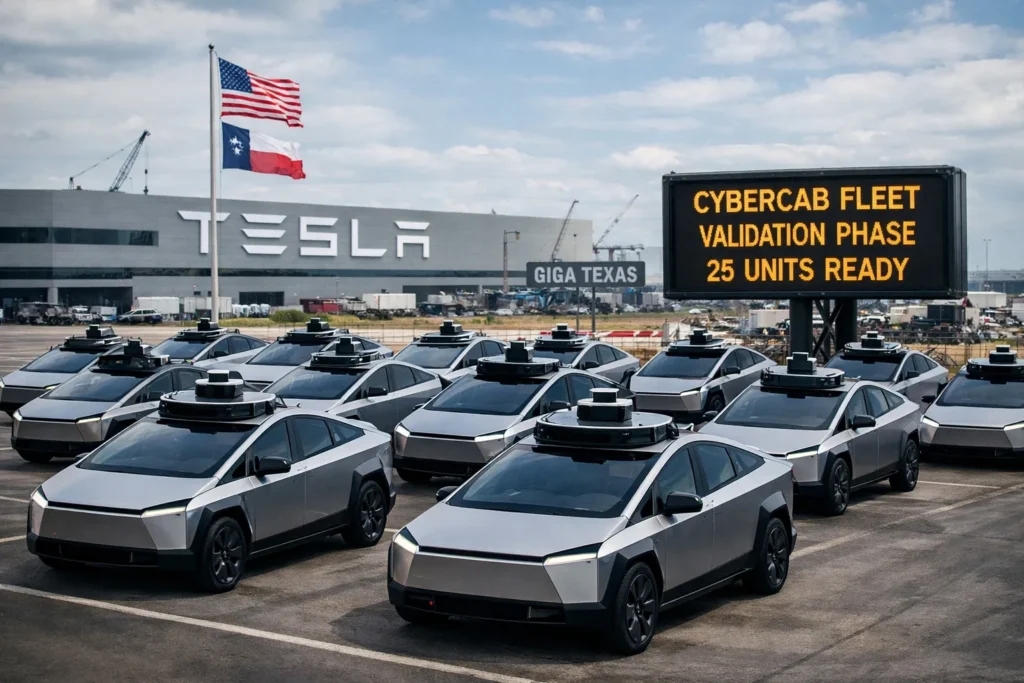
- Now — Cybercab testing and validation fleets growing at Giga Texas
- Mid-2026 — Expanded unsupervised robotaxi service in multiple U.S. cities (Texas, California, and more)
- Late 2026 — High-volume production and broader rollout, potentially including international markets
- 2027+ — Consumer ownership of Cybercabs and massive robotaxi fleet revenue
Tesla executives have hinted at real-world Austin deployments soon, and new Texas laws are already clearing the path for driverless operations.
Public and Expert Reactions to the Cybercab Video
The internet exploded with excitement:
- Fans called it “the future arriving today”
- Critics questioned timelines (a common Elon Musk pattern)
- Enthusiasts noted the irony of “unemployed” robotaxis driving past traditional cars
One viral reply summed it up perfectly: “2026 is crazy… cars are now driving themselves out of factories while some people still can’t reverse park.”
How the Cybercab Will Transform Transportation
- Lower costs — Expect ride prices far below Uber/Lyft
- Safety boost — FSD has shown strong results with zero crashes in recent supervised testing
- Accessibility — Elderly and disabled users gain independence
- Environmental impact — All-electric, zero-emission fleet
Tesla’s vision: A world where owning a car is optional, and robotaxis handle 90%+ of urban miles.
Frequently Asked Questions (FAQ)
When will the Cybercab be available for rides?
Unsupervised robotaxi service is expanding rapidly in 2026, starting in Texas and California.
How much will Cybercab rides cost?
Elon Musk targets ~$0.20 per mile — potentially cheaper than public transit.
Can I buy a personal Cybercab?
Yes — consumer versions are planned, with production scaling in 2026–2027.
Is the Cybercab safe?
Tesla’s FSD is improving weekly, backed by billions of real-world training miles.
Where is the Cybercab made?
Exclusively at Giga Texas in Austin.
Ready for the Autonomous Future?
Elon Musk’s latest Cybercab video isn’t just viral content — it’s a glimpse into a world where cars drive themselves from the factory to your doorstep. Tesla is no longer promising the future; it’s delivering it, one self-driving robotaxi at a time.