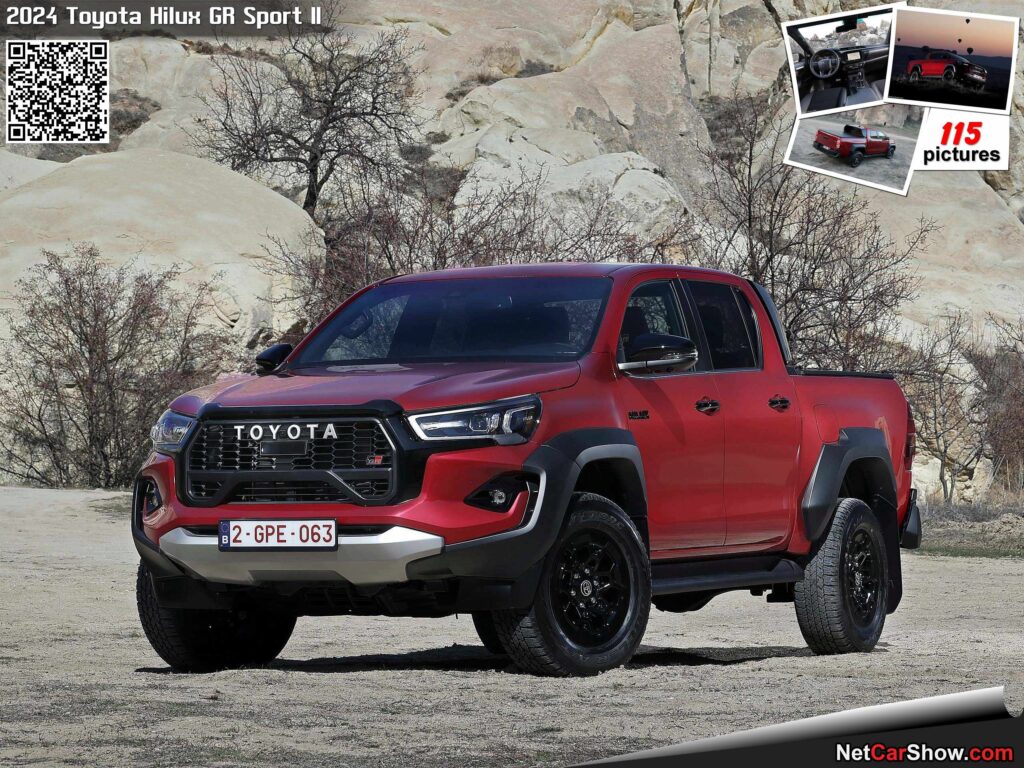
What is the Toyota GR Hilux?
Search “Toyota GR Hilux” and you will hit three related machines:
- Hilux GR Sport / GR Sport II — the factory production pickup sold in Australia, Europe, Southeast Asia, the Middle East and parts of Latin America.
- GR DKR Hilux EVO T1+ — Toyota Gazoo Racing’s works Dakar Rally truck, with a Land Cruiser 300 twin-turbo V6 and spaceframe chassis.
- DKR GR FC Hilux — the new hydrogen fuel-cell Dakar prototype, revealed in mid-September 2026 for the 2027 event.
The GR badge does not turn the Hilux into a GR Yaris or GR Supra. On the street truck it means wider tracks, retuned suspension, extra power in some markets, Dakar-inspired styling and a locking rear differential. On the race truck it means a purpose-built T1+ rally weapon that has won Dakar four times (2019, 2022, 2023, 2025).
That distinction matters. Buyers who expect a Raptor-style 400 hp desert missile will be disappointed by the road car. Buyers who want the toughest factory Hilux with real chassis work will not.
Hilux GR Sport design: Dakar cues, work-truck bones
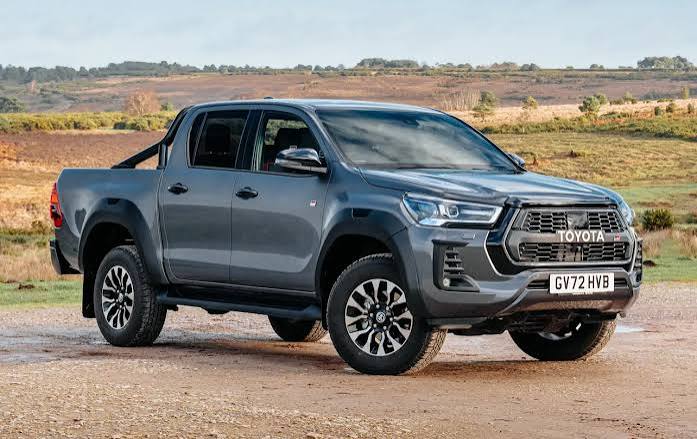
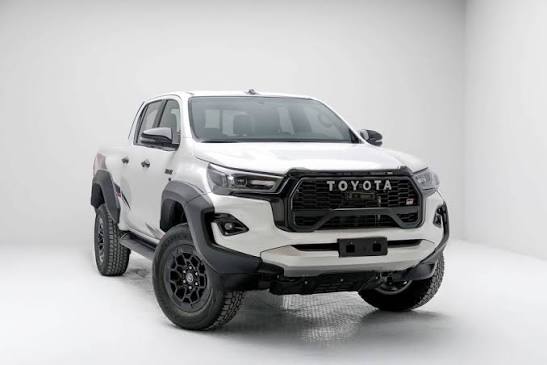
The GR Sport is still a ladder-frame double-cab pickup. What changes is the stance.
Toyota widened the front track by about 135–140 mm and the rear by 150–155 mm versus a standard Hilux. Ride height is up 15–20 mm. Approach angle rises from 29° to 30°. The result is a truck that looks planted, not just dressed up.
Signature details:
- Black honeycomb grille with bold TOYOTA lettering and a small GR badge
- Flared wheel arches and black cladding
- Silver skid plate / lower bumper
- 17-inch black alloys on all-terrain tyres (18-inch in some markets)
- Sports bar and soft load cover on many European specs
- Dark mirrors, handles and badging
It is aggressive without looking like an aftermarket body kit — which is useful to know in India, where GR-style kits are sold separately because Toyota Kirloskar does not offer a factory GR Sport Hilux.
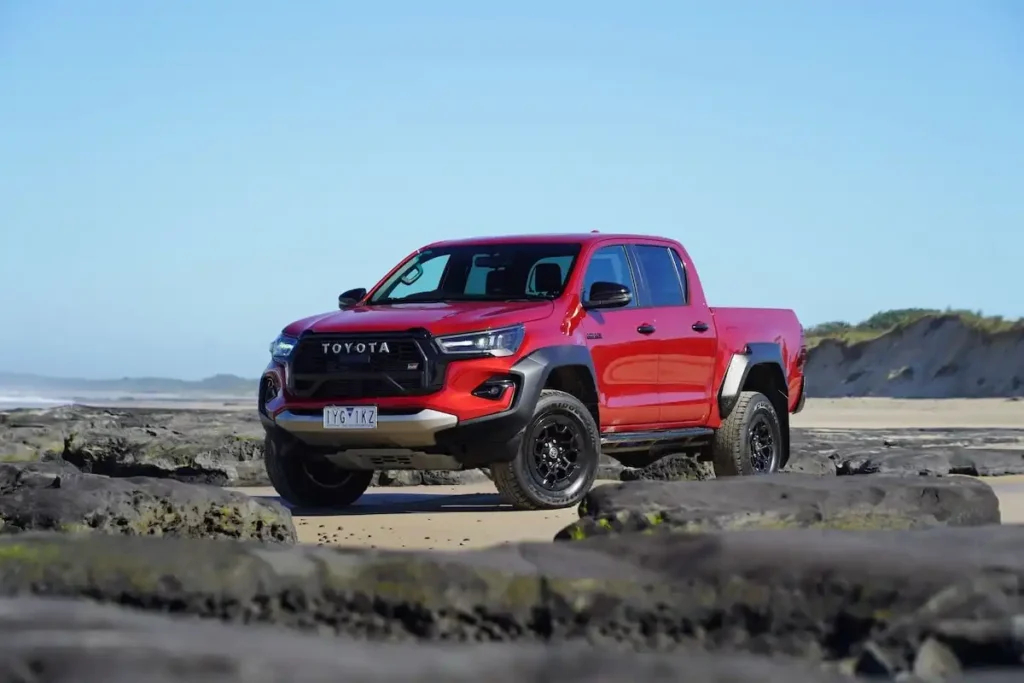
Engine and performance: same family, different tunes
Power depends on the market. Toyota did not give every region the same calibration.
| Market | Engine | Power | Torque | Gearbox |
|---|---|---|---|---|
| Australia | 2.8L 4-cyl turbo-diesel | 165 kW (221 hp) | 550 Nm | 6-speed auto |
| Europe (GR Sport II) | 2.8L 4-cyl turbo-diesel | 150 kW (204 hp) | 500 Nm | 6-speed auto |
| Malaysia | 2.8L 4-cyl turbo-diesel | 224 PS | 550 Nm | 6-speed auto |
| Middle East (some GR-Sport) | 4.0L V6 petrol | ~235 hp | ~376 Nm | 6-speed auto |
The Australian tune is the one enthusiasts talk about: a 10% lift over a regular 2.8 Hilux, plus a recalibrated automatic. Claimed economy is 8.1 L/100 km. 0–100 km/h is around 10.7 seconds in European form; Australian testers have recorded closer to the mid-9s in some conditions. Top speed is typically 175 km/h.
Drive is part-time 4WD with high and low range and a locking rear differential. That is the correct hardware for a work-and-adventure pickup. It is not the full-time, multi-mode desert setup of a Ford Ranger Raptor.
Towing stays at the class benchmark of 3,500 kg braked in Australia and Europe. Payload is the catch on the Australian GR Sport: extra mass cuts payload to about 780 kg, versus roughly a tonne on some other Hilux grades. European GR Sport II quotes are more generous, up to around 1,000 kg depending on spec. Always check the local VIN plate.
Chassis: where the GR badge actually earns its keep
Styling sells the truck. The chassis is why reviews treat it as more than a badge job.
- KYB monotube dampers replace twin-tube shocks, with larger pistons for faster response
- Springs retuned for the wider track
- Rear anti-roll bar deleted on some specs to increase wheel travel
- Larger front discs; ventilated rear discs replace drums on GR Sport II
- Ground clearance around 265 mm in Australia and up to 323 mm on some European / export figures
- Wading depth commonly quoted at 700 mm (some markets claim 800 mm)
On dirt and gravel the wider track reduces body roll and keeps the truck calmer at speed. On broken tarmac the ride is still a leaf-sprung pickup — better than a base Workmate, not as supple as a Ranger Raptor on Fox shocks. That is the honest trade-off.
Off-road aids include Multi-Terrain Select on some markets, Downhill Assist Control, Hill-start Assist and Trailer Sway Control.
Cabin and equipment
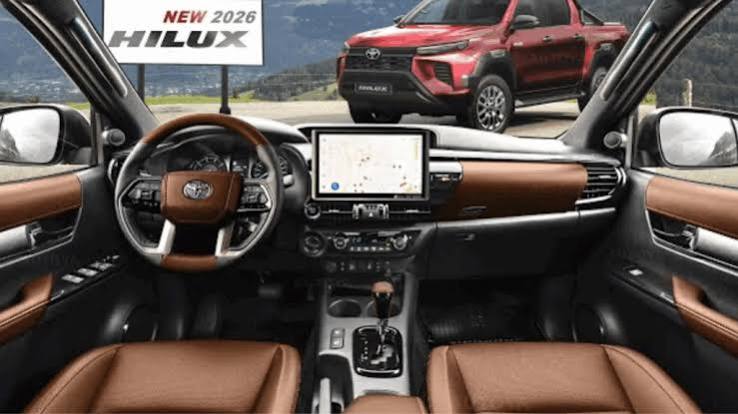
The cabin is still eighth-generation Hilux architecture in most current GR Sports: upright, durable, and only recently brought up to modern screen sizes.
Typical flagship kit:
- Leather or leather/suede GR seats with red or silver stitching
- Power driver’s seat
- 8-inch or newer 12.3-inch touchscreen, depending on model year
- Wireless or wired Apple CarPlay and Android Auto
- JBL audio on higher European specs
- 360-degree camera, blind-spot monitoring, rear cross-traffic alert
- Adaptive cruise, lane departure alert, AEB with pedestrian detection
- Paddle shifters on some cars
The ninth-generation Hilux rolling out in 2025–2026 (already launched in India and Japan) modernises the dash across the range. A factory GR Sport for that new generation has not been confirmed in every market yet.
Toyota GR Hilux price (2025–2026)
Prices are list figures before on-roads unless noted.
- Australia: from about AUD $73,990–$75,310
- United Kingdom: GR Sport II from £49,750 OTR
- Germany / Europe: from about €65,580
- Malaysia: from RM 173,280
- India: no official GR Sport. The 2026 Hilux range starts at ₹31.99 lakh (GX 4×2 AT) and goes to ₹36.69 lakh (VX 4×4 AT), ex-showroom. Aftermarket GR-style kits start from roughly ₹50,000 and full bundles can exceed ₹1.7 lakh.
Resale is a Hilux strength. In used-value studies the GR Sport typically holds more of its price than a Ranger Raptor, which is the rational argument if you are choosing with a spreadsheet rather than a stopwatch.
India: can you buy a Toyota GR Hilux?
Not from a Toyota dealer as a factory model.
Toyota Kirloskar sells the Hilux as a premium lifestyle pickup, now in ninth-generation form with a 2.8-litre diesel, 204 hp / 500 Nm, 6-speed automatic only, and 4×2 or 4×4. There is no GR Sport, no extra 15 kW, and no factory wide-track package. What exists is aftermarket GR styling — grille, arches, roll bar, lights — plus the usual Indian accessory catalogue of snorkels, lift kits and liners.
If a factory GR Sport ever arrives, it will likely sit above the VX and be priced well into the ₹40 lakh-plus zone after on-road costs. Until then, the closest official GR product in India is the Fortuner GR-S / Land Cruiser 300 GR-S, not the Hilux.
The other GR Hilux: Dakar’s GR DKR
This is the truck that justifies the badge.
The GR DKR Hilux EVO T1+ is a tubular spaceframe with composite Hilux body panels. It is not a modified production pickup. Key numbers:
- Engine: 3.5-litre twin-turbo V6 (V35A) from the Land Cruiser 300
- Output (FIA-capped): about 298 kW / 400 hp and 660 Nm (figures have been reduced in some seasons by regulation)
- Gearbox: Sadev 6-speed sequential
- Suspension: double wishbone, 350 mm travel
- Tyres: 37-inch BF Goodrich
- Fuel cell: 540-litre FT3 safety tank
- Weight: ~2,010 kg dry (FIA minimum)
- Top speed: FIA-limited around 170 km/h
Toyota Gazoo Racing has used this programme to win Dakar and to feed durability lessons back into the road Hilux. That loop is the marketing line, and it is only half spin: the production GR Sport’s monotube dampers, track width and brake upgrades are the visible leftovers of a racing brief.
Breaking news: DKR GR FC Hilux goes to Dakar on hydrogen
On 17 September 2026, Toyota unveiled the DKR GR FC Hilux — a fuel-cell version of the Dakar truck for the 2027 rally’s Future Mission 1000 class. It shares bodywork and chassis with the V6 race truck. The combustion engine is gone. A Toyota fuel-cell stack feeds electric motors. Tailpipe output is water vapour.
Toyota has not published motor output or stage range. Partners include Jameel Motorsport, Denso, Toyo Tires and IAV. The V6 GR DKR will still chase the overall win; the FC truck is a technology test under heat, dust and 1,000 km of special stages.
The commercial link is already public: a road-going Hilux Fuel Cell is scheduled for 2028, targeting more than 400 km (248 miles) of range and 2,500 kg of towing. That sits beside the Hilux BEV (shorter range, lower tow rating) and the mild-hybrid diesel. Toyota is running a multi-pathway strategy rather than betting the pickup only on batteries.
Toyota GR Hilux vs Ford Ranger Raptor
This is the comparison every review makes, and the answer is consistent.
The Ranger Raptor (3.0 twin-turbo V6 petrol, ~292 kW in many markets, Fox racing shocks, 10-speed auto, full-time 4WD modes) is faster, more comfortable at speed on corrugations, and more of a toy. The Hilux GR Sport is cheaper in most regions, more fuel-efficient, better as a work truck, and holds value. It will not win a drag race or a high-speed dune run against the Raptor. It will still be earning money or crossing a farm when the Raptor is in the workshop.
Closer rivals for the GR Sport are the Ranger Wildtrak / Wildtrak X, Volkswagen Amarok Aventura and, in some markets, the Mitsubishi Triton GSR.
Who should buy a Toyota GR Hilux?
Buy the GR Sport if you want:
- The most capable factory Hilux you can order
- 3.5-tonne towing and a usable tray
- Proven diesel reliability and high resale
- Dakar looks without a Raptor price
Skip it if you want:
- A true high-speed desert truck (get a Raptor)
- Maximum payload (a lower Hilux grade may carry more)
- A factory GR Hilux in India (it does not exist yet)
- The latest cabin tech (wait for a ninth-gen GR Sport if your market gets one)
Frequently asked questions
Is the Toyota GR Hilux a real GR car?
It is a GR Sport, not a full GR homologation special. Chassis, brakes and (in Australia) engine output are upgraded. It is not a race car with number plates.
Does India get the Hilux GR Sport?
No factory variant as of September 2026. Aftermarket GR kits are widely sold.
What engine is in the Dakar GR Hilux?
A 3.5-litre twin-turbo V6 from the Land Cruiser 300, power-capped by FIA rules. The new FC version uses a hydrogen fuel cell instead.
When is the hydrogen Hilux coming to showrooms?
Toyota has targeted 2028 for a production Hilux FCEV, separate from the 2026–27 Hilux BEV already reaching some markets.
How much can the Hilux GR Sport tow?
3,500 kg braked in Australia and Europe. Confirm payload if you plan to tow at the limit with a loaded tray.
The Toyota GR Hilux works best when you treat it as two stories at once: a wide-track, Dakar-styled diesel pickup you can buy today in many countries, and a racing programme that is now testing hydrogen in the Saudi desert so a fuel-cell Hilux can follow in 2028. The badge is marketing. The wider tracks, monotube dampers and Dakar wins are not.